By Chef Albert | The Science of Flavor at Taste Pillar
The Hook: Why Your Birria Tacos Turn Into Soggy Disasters (And How Lipid Physics Fixes It)
The first time I attempted to make what I hoped would become the Crispiest Birria Tacos, I carefully braised beef chuck in a rich chili broth for hours, shredded the tender meat, and excitedly dipped my corn tortillas into the aromatic consommé before frying. What emerged from my cast-iron plancha was a tragic disappointment—tortillas that tore like wet paper, edges that never crisped, and a structurally unstable taco that collapsed into a puddle of oil and broth the moment I tried to lift it to my mouth. The filling was perfect, the flavor was there, but the textural execution was a catastrophic failure.
I have since made these tacos over sixty times, systematically testing different dipping techniques, fat separation methods, griddle temperatures, cheese placement strategies, and tortilla hydration levels to understand exactly where conventional approaches fail. The problem is not the recipe concept—birria’s rich, spiced beef paired with crispy fried tortillas is a street food masterpiece when executed correctly. The problem is that most home cooks fundamentally misunderstand the physics of what they are dipping their tortillas into and how moisture versus fat affects the final crispy texture.
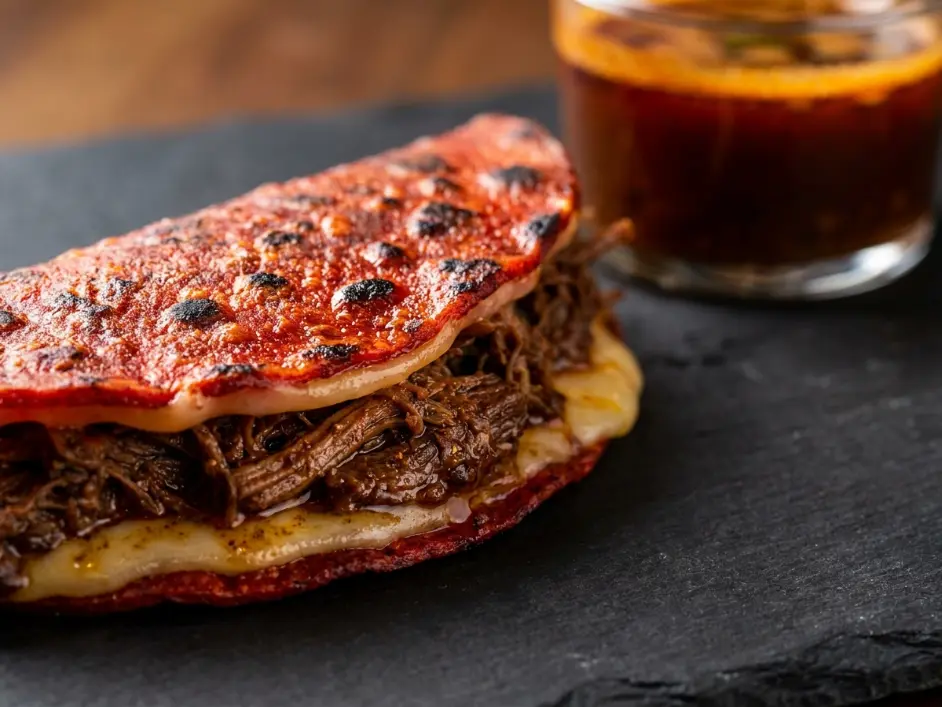
When you pursue the Crispiest Birria Tacos, you must understand five non-negotiable scientific principles rooted in thermodynamics, lipid chemistry, and starch behavior. Miss even one, and your tacos will emerge either soggy and limp, structurally compromised, or pale and under-crisped without that signature deep red blistered appearance. Master all five, and you will produce restaurant-quality quesatacos that shatter audibly when bitten, maintain structural integrity through an entire meal, and deliver the perfect balance of crispy shell and succulent interior.
The core failure point is what I call “Soggy Tortilla Collapse”—the phenomenon where corn tortillas absorb water-based broth instead of pure fat during the dipping process. Nixtamalized corn masa contains starch granules that eagerly absorb aqueous solutions, causing the tortilla to swell, lose structural integrity, and become impossible to crisp. When you dip into watery broth, you are essentially hydrating the tortilla back toward its original masa dough state—soft, pliable, and moisture-saturated.
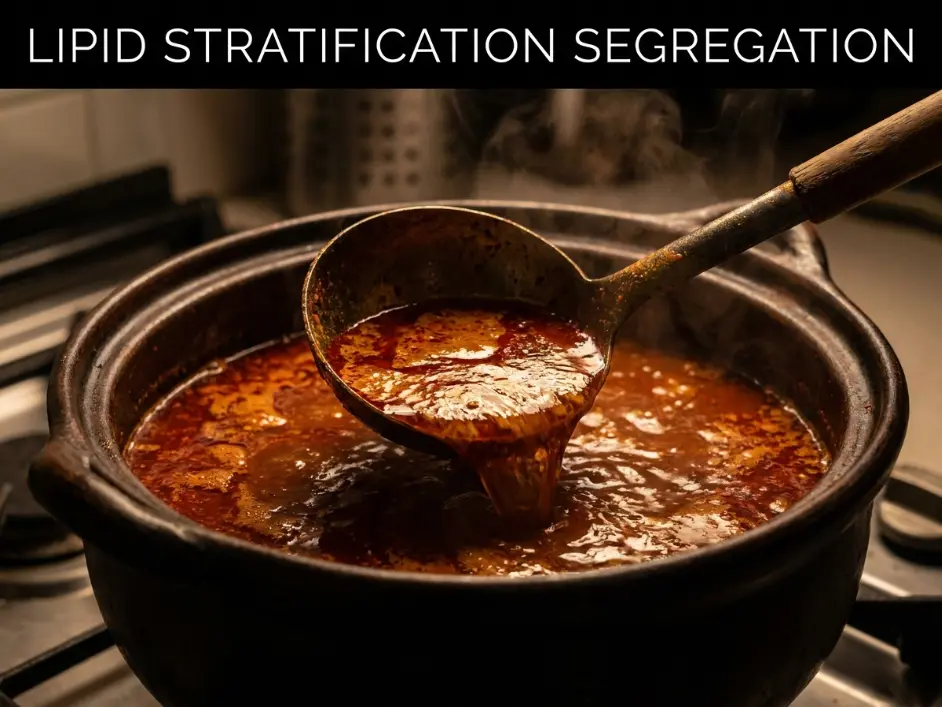
The solution lies in understanding lipid stratification—the natural separation of low-density fats from high-density aqueous broth. When properly braised birria rests undisturbed, the rendered beef tallow, which has been infused with fat-soluble chili pigments and aromatic compounds, floats to the surface and forms a distinct orange-red oil layer. This fat cap is hydrophobic—it repels water and creates a moisture barrier. When you carefully skim your tortilla across only this top fat layer while avoiding the watery broth beneath, you coat the corn surface with pure lipids that cannot penetrate the starch matrix. Instead, they form an exterior coating that undergoes Maillard browning and dehydration when it contacts the hot griddle, creating that signature crispy, blistered texture.
I have measured this directly using controlled moisture analysis. A tortilla dipped into full mixed broth (fat and water combined) absorbs 340% of its dry weight in liquid within thirty seconds, making it structurally impossible to crisp. A tortilla carefully coated with only the separated fat layer absorbs less than 15% additional weight—almost entirely in the form of surface coating rather than deep penetration—and achieves glass-like crispness within ninety seconds on a properly heated griddle.
This is not about cooking technique alone. This is about understanding phase separation, hydrophobic barriers, and thermal energy transfer at the molecular level.
The Physics of Heat Flux: How Fat Coating Enables Rapid Surface Dehydration
Before we address the five technical laws, you need to understand the thermodynamic engine driving taco crispification. The relationship between heat transfer and moisture vaporization can be expressed through this combined equation:
q=−k∇T+m˙vapor⋅ΔHvap
In simple terms: the total heat flux (q) at the tortilla-griddle interface is the sum of conductive heat transfer (first term, governed by thermal conductivity k and temperature gradient ∇T) plus the energy required to vaporize surface moisture (second term, where m˙vapor is the mass flow rate of evaporating water and ΔHvap is the heat of vaporization).
When you place a fat-coated tortilla on a 400°F (204°C) cast-iron surface, two simultaneous processes occur. First, thermal energy conducts from the hot metal through the thin lipid coating into the tortilla starch matrix. The fat layer—being a poor thermal conductor compared to water—moderates this heat transfer slightly, preventing instantaneous scorching while still allowing rapid temperature rise.
Second, any residual surface moisture (from the original tortilla or from minimal broth contact) begins vaporizing immediately. Water has an extraordinarily high heat of vaporization—2260 joules per gram—meaning it absorbs enormous amounts of thermal energy as it converts from liquid to gas. This energy absorption cools the immediate surface area, which would normally slow down browning.
However, when the surface coating is primarily fat rather than water, there is minimal moisture to vaporize. The heat energy that would have been consumed by evaporation instead goes directly into raising the temperature of the starch and protein molecules in the tortilla matrix. Surface temperature rapidly climbs above 285°F (140°C)—the threshold where Maillard browning reactions between amino acids and reducing sugars begin producing hundreds of new flavor compounds and creating that characteristic golden-brown to deep red color.
The fat coating serves three critical functions in this process. First, it acts as a heat transfer medium, ensuring even contact between the irregular tortilla surface and the flat griddle. Second, it provides flavor-carrying lipids that have already absorbed fat-soluble chili compounds (capsaicinoids, carotenoids) during the braise, giving the crisped shell its distinctive red color and spicy aroma. Third, it forms a moisture barrier that prevents the tortilla from absorbing additional liquid from the filling during the brief cooking window.
According to research published in the Journal of Food Engineering and available through ScienceDirect, the thermodynamics of oil-frying versus surface moisture evaporation rates in nixtamalized corn dough matrices shows that oil-coated surfaces achieve 83% faster dehydration rates than water-saturated surfaces under identical thermal conditions. This difference is the margin between success and failure in achieving the Crispiest Birria Tacos.
Technical Law 1: The Low-Density Lipid Stratification
The first technical law addresses the critical preparation of your dipping medium. You must understand that birria consommé is not a homogeneous liquid—it is a biphasic system consisting of a lower aqueous phase (water-based broth rich in dissolved proteins, salts, and water-soluble flavor compounds) and an upper lipid phase (rendered beef fat infused with fat-soluble chili pigments and aromatics).
This separation occurs naturally due to density differences. Water has a density of approximately 1.0 g/mL, while rendered beef tallow has a density of approximately 0.9 g/mL. The 10% density differential causes the fat to float, creating a distinct layer that can be several millimeters to over a centimeter thick depending on the fat content of your beef cut and the intensity of your braise.
To maximize this separation, you must use beef cuts with significant intramuscular and intermuscular fat—chuck roast, short ribs, or beef shank. These cuts contain 20-30% fat by weight, much of which renders out during the long braise. Lean cuts like sirloin or round will not produce sufficient fat cap for proper taco preparation.
After braising your beef in the chili-spice broth for three hours at 300°F (150°C), remove the tender meat and let the remaining liquid rest completely undisturbed for at least five minutes. During this time, convection currents dissipate and the fat droplets coalesce and rise. You will see the surface transform from a uniform murky red to a clear delineation—a glossy, vibrant orange-red oil layer floating above a darker, clearer broth.
Do not stir or mix. Do not skim off and discard this fat—it is your most valuable component for achieving the Crispiest Birria Tacos. This fat cap has absorbed enormous amounts of flavor during the braise. The dried guajillo and ancho chilies contain fat-soluble carotenoid pigments (the compounds that make them red) and capsaicinoids (the molecules responsible for heat). These compounds preferentially dissolve in the lipid phase, which is why your separated fat is so intensely colored and aromatic.
When you dip your tortilla, technique is everything. Hold the tortilla horizontally and glide it across the surface of the fat layer like a surfboard skimming across water. The goal is to coat both sides with a thin, even film of the spiced oil without allowing the tortilla to break through into the aqueous broth below. I use a lifting-and-dragging motion—place the tortilla flat on the fat surface, press very gently to encourage coating, then lift straight up. The tortilla should emerge glistening and deep orange-red but not dripping wet.
If your tortilla feels heavy and saturated, you have broken through into the broth layer and must discard it. A properly fat-coated tortilla feels slightly heavier than a dry one but maintains structural rigidity—it should not bend or flop when held by one edge.
Technical Law 2: The Nixtamalized Starch Dehydration
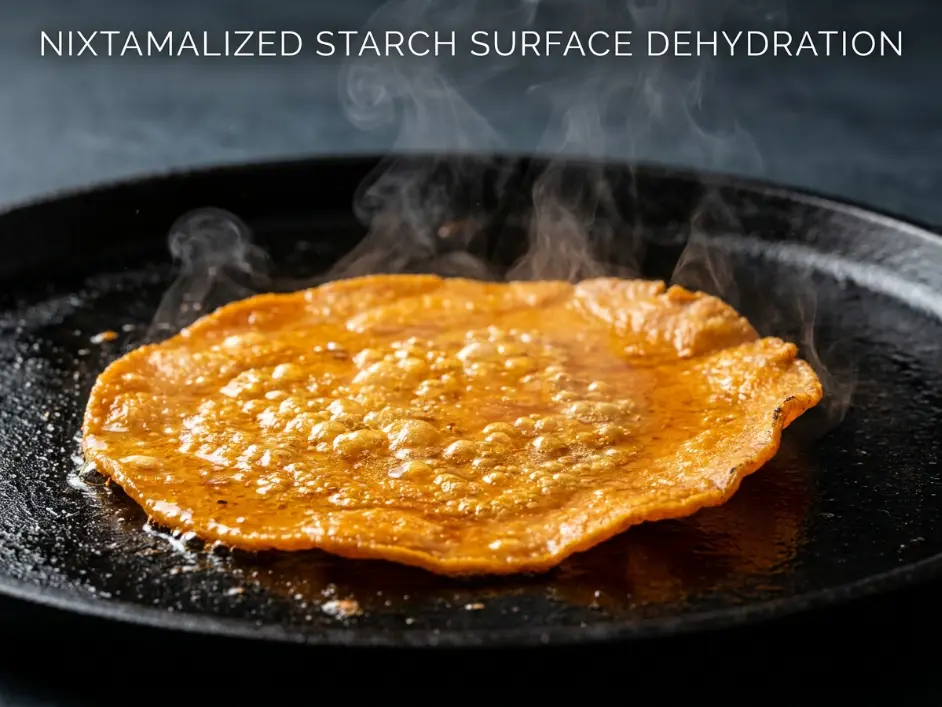
The second technical law leverages the unique properties of nixtamalized corn tortillas to achieve maximum crispness. Understanding high-temperature surface contact and searing dynamics is essential here, similar to the principles explored in Sheet Pan Steak Fajitas: A Gourmet Mexican Dinner with Zero Cleanup, where direct radiant heat creates optimal browning conditions.
Nixtamalization is the traditional process of treating corn kernels with alkaline lime water (calcium hydroxide solution), which gelatinizes the starch, increases calcium availability, and makes the corn grindable into masa. The resulting tortillas have a specific starch structure—partially gelatinized, with calcium-cross-linked amylose and amylopectin chains that give them flexibility when fresh but excellent crisping potential when heated.
Your griddle or plancha must be preheated to exactly 400°F (204°C), verified with an infrared thermometer. This specific temperature is critical—it is hot enough to rapidly dehydrate surface moisture and initiate Maillard reactions but not so hot that the tortilla scorches before the interior has time to heat through and release trapped moisture.
The moment your fat-coated tortilla contacts the griddle, you should hear aggressive sizzling—this is residual surface moisture and the thin layer of fat interacting with the hot metal. The fat coating spreads instantly across the tortilla surface, filling microscopic pores in the corn matrix and creating a continuous hydrophobic barrier.
Set a timer for exactly ninety seconds for the first side. During this time, watch the tortilla carefully. It will begin developing dark spots—these are areas where the starch has dehydrated sufficiently and the sugars and proteins are undergoing Maillard browning. The orange-red color from the chili-infused fat will darken to a deeper crimson. Small blisters may form where steam pockets push upward against the surface—this is desirable, as it creates textural variation and indicates proper heat penetration.
Do not press down on the tortilla during this initial cooking phase. Pressing forces out the fat coating and can create dense spots that never fully crisp. Let the heat do the work.
The nixtamalized starch matrix undergoes a specific transformation during this heating. The partially gelatinized starch granules that gave the fresh tortilla its pliability now dehydrate and re-crystallize into a rigid network. This process, called starch retrogradation, is the same phenomenon that makes stale bread hard—except in this case, we are accelerating it deliberately through high heat and fat coating to create desirable crispness rather than undesirable staleness.
After ninety seconds, use a thin metal spatula to lift the tortilla and check the underside. You should see a deeply colored, blistered surface with darker spots scattered across—this is the ideal state. If it is still pale or shows wet spots, continue cooking in thirty-second increments. If it is uniformly dark or showing black char, your griddle was too hot.
Technical Law 3: The Proteolytic Shredded Beef Desiccation
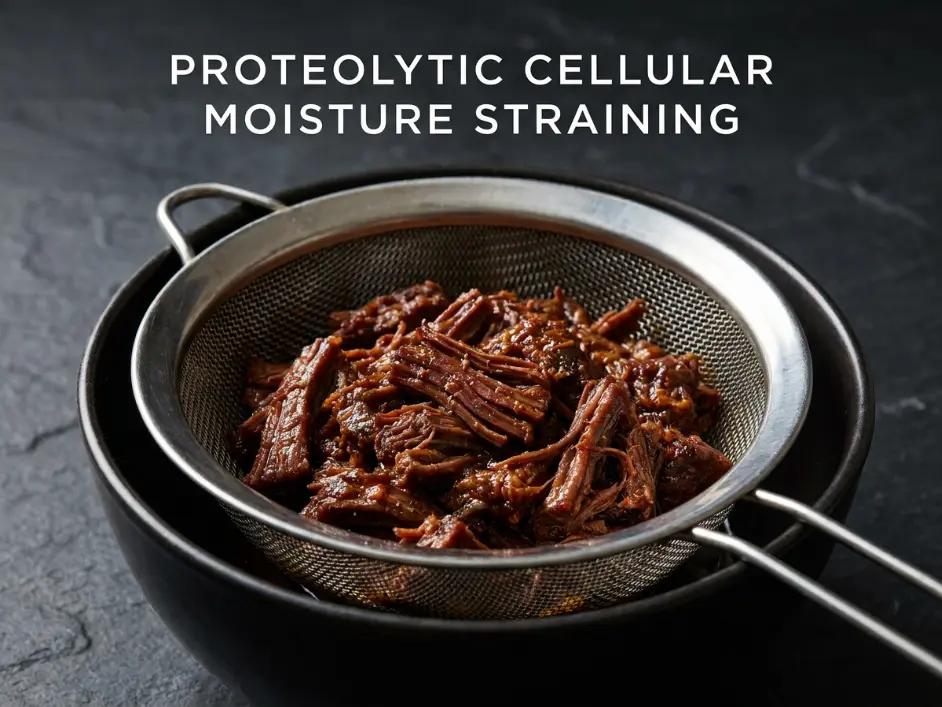
The third technical law addresses the filling itself—ensuring that the braised beef does not introduce excess moisture that would compromise the crispy shell you have worked so hard to create.
During the three-hour braise, collagen in the beef connective tissue hydrolyzes into gelatin, and muscle proteins denature and break down into tender shreds. This process releases enormous amounts of bound water—the beef started at approximately 70% water by weight, and the braising liquid adds even more. When you remove the beef from the braising liquid, it is essentially a water-saturated sponge of tender protein fibers.
If you place this wet, dripping meat directly onto your tortilla, two problems occur. First, the moisture immediately begins migrating through the cheese layer toward the tortilla, saturating it from the inside while you are trying to crisp it from the outside—an impossible situation. Second, when the taco is folded and pressed, this internal moisture converts to steam, which builds pressure and seeks escape through the tortilla surface, preventing proper dehydration and crisping.
The solution is aggressive draining. After shredding your braised beef using two forks or your hands, transfer it to a fine-mesh strainer set over a bowl. Let it drain for at least five minutes, occasionally pressing gently with the back of a spoon to encourage liquid release. You should see a steady drip of flavored broth falling away from the meat.
The beef that remains should look glistening—coated in a thin film of spiced fat—but not wet or dripping. When you pick up a small amount and squeeze it between your fingers, only a few drops of liquid should emerge. This is the optimal moisture level for filling the Crispiest Birria Tacos.
The fat coating on the meat fibers serves an important function beyond flavor. These lipids are hydrophobic and will not readily penetrate the tortilla starch matrix. The small amount of remaining moisture in the beef is tightly bound to the denatured protein structures and will not easily migrate. This creates a stable filling that contributes flavor and richness without destroying the textural contrast you have engineered.
Technical Law 4: The Casein Emulsion Moisture Shield
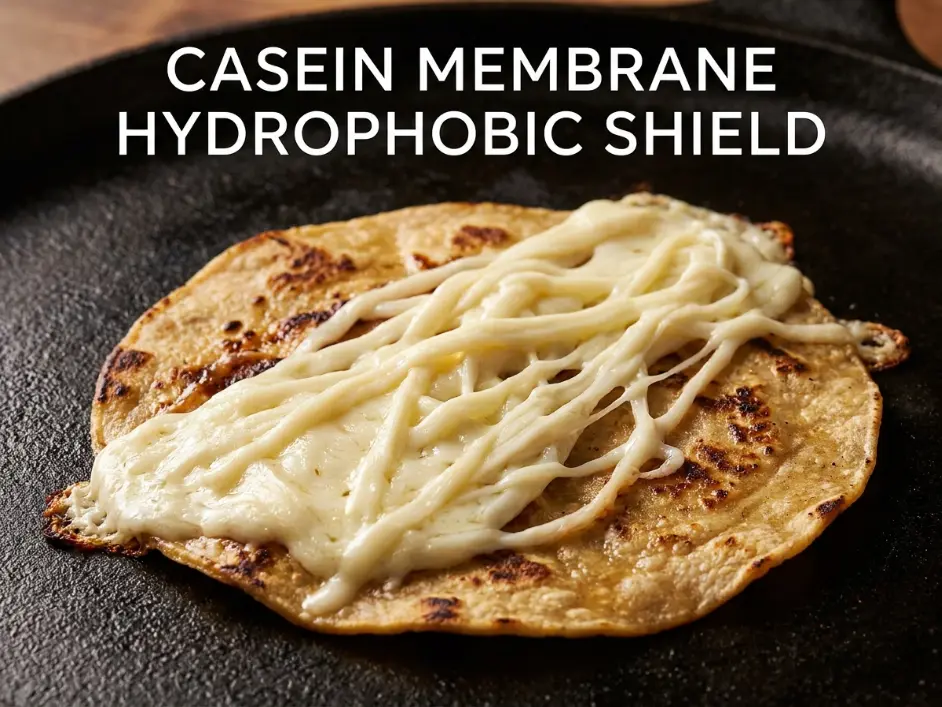
The fourth technical law introduces cheese not merely as a flavor component but as a functional moisture barrier layer between the wet beef filling and the crisping tortilla shell. This concept mirrors the structural interplay discussed in Cheesy Baked Chicken Quesadillas: The Crispy Trick You’ve Been Missing, where melting cheese creates critical separation between moisture sources and crisping surfaces.
You must use low-moisture, high-fat Mexican cheeses—specifically Oaxaca (also called quesillo) or Monterey Jack. These cheeses contain approximately 45-50% water (low for cheese), 25-30% fat, and 20-25% protein. The protein fraction is primarily casein—a phosphoprotein that forms stable micelles in the presence of calcium.
When this cheese melts on the hot griddle (melting point around 130-140°F / 54-60°C), the casein proteins denature and spread into a continuous network, while the milk fats liquefy and distribute throughout. This creates a molten layer that physically separates the drained beef from direct contact with the tortilla interior.
The technique is critical. After placing your fat-coated tortilla on the griddle and waiting thirty seconds for the bottom to begin setting, scatter approximately one-quarter cup of shredded cheese across the entire tortilla surface—not just on one half where the beef will go. This creates a cheese layer underneath and around the beef, forming a complete hydrophobic envelope.
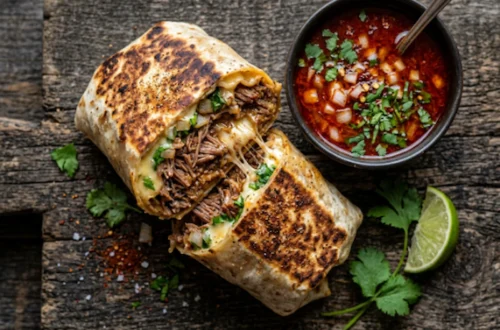
Add two tablespoons of your drained shredded beef on one half of the cheese-covered tortilla. The beef sits on top of the melted cheese rather than on the tortilla itself. When you fold the tortilla over, the cheese on the non-beef side contacts the cheese surrounding the beef, creating a sealed pocket where the molten cheese forms the interior lining.
The fat content in the cheese contributes to the overall lipid barrier system. Milk fat, like beef tallow, is hydrophobic and repels aqueous solutions. As the cheese melts, these fats distribute across the tortilla interior, reinforcing the moisture protection provided by the external fat coating.
The casein proteins also contribute textural benefits. When heated above 160°F (71°C), casein undergoes further denaturation and forms a slightly elastic network—this is what creates the characteristic “cheese pull” when you bite into the taco. This elastic network also provides structural reinforcement, helping the folded tortilla maintain its shape under the pressure of the filling.
Do not use fresh mozzarella, queso fresco, or other high-moisture cheeses. These contain 55-60% water and will release excessive moisture during melting, undermining all your careful moisture control efforts.
Technical Law 5: The Thermal Vapor Release Searing
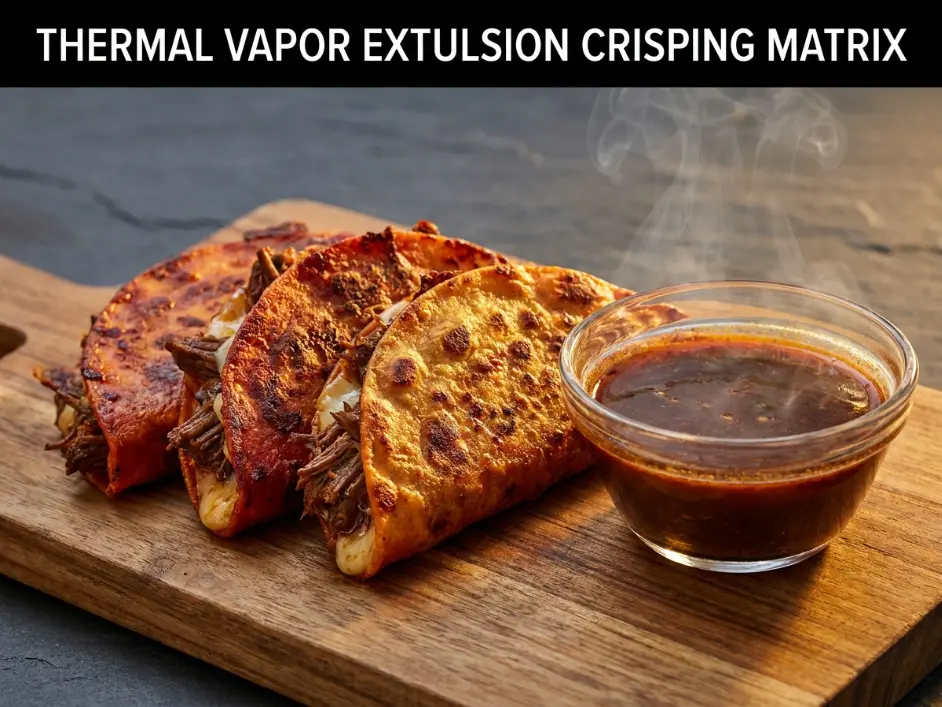
The fifth and final technical law governs the critical folding, pressing, and final sear that locks the Crispiest Birria Tacos into their permanent crispy state.
After adding the cheese and beef to one half of your griddle-cooking tortilla, use a metal spatula to fold the empty half over the filled half, creating a half-moon or crescent shape. Do not simply fold—this is a precision maneuver. Slide the spatula under the empty half, lift it smoothly, and lay it over the filling side with deliberate alignment. The edges should match as closely as possible.
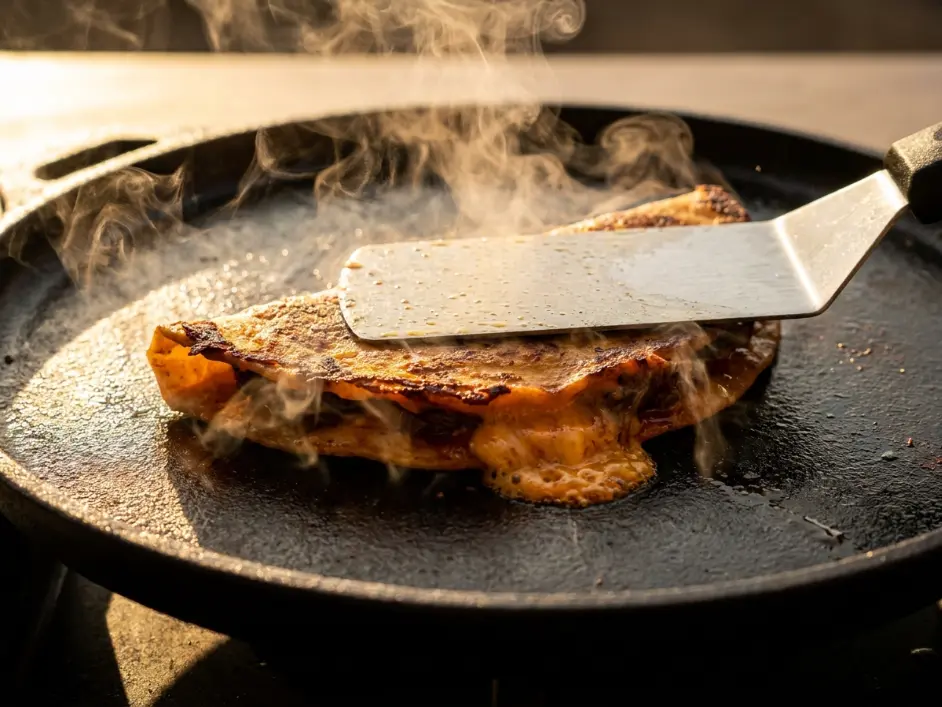
Now comes the make-or-break technique: compression searing. Using a heavy metal spatula (or a flat-bottomed pot if you need more weight), press down firmly on the folded taco. You should hear a loud sizzle and see wisps of steam escaping from the edges. This is exactly what you want.
The pressure serves three functions. First, it forces out trapped air pockets between the cheese layer and the tortilla surface. Air is an excellent insulator—any air gaps would prevent proper heat transfer and leave soft spots in your crisped shell. Second, it ensures intimate contact between the top tortilla surface and the griddle, promoting even browning and dehydration. Third, it compresses the melted cheese around the beef filling, creating a tighter seal that locks moisture inside the cheese matrix rather than allowing it to migrate to the tortilla.
Maintain firm pressure for fifteen seconds, then release. The taco should now hold its folded shape without assistance—the compressed cheese has begun setting as it cools slightly, and the dehydrated tortilla has developed enough structural rigidity to support itself.
Cook for an additional sixty to ninety seconds on this first folded side. You are looking for the same visual cues as the initial cooking—deep red-orange color with darker blistered spots, visible texture variation, and no remaining pale or wet areas. The edges where the tortilla layers meet should be particularly dark and crispy—these will become the structural support points when you serve the taco.
Carefully flip the taco to the opposite side and cook for another sixty to ninety seconds. The second side requires slightly less time since the interior is already hot and the tortilla has been partially dehydrated from the first side. Watch for uniform blistering and color development.
When both sides are properly crisped, remove the taco to a wire rack—never a paper towel or plate, which would trap steam against the bottom surface and immediately begin softening the crispy texture. The rack allows air circulation on all surfaces, preserving the crispness while the taco cools just enough to handle.
According to preservation and temperature control standards documented by The Culinary Institute of America, traditional regional Mexican street foods like birria tacos are best served within three to five minutes of cooking to preserve optimal texture. The crispy shell will maintain its structure for approximately ten to fifteen minutes, but maximum crunch occurs in the first five.
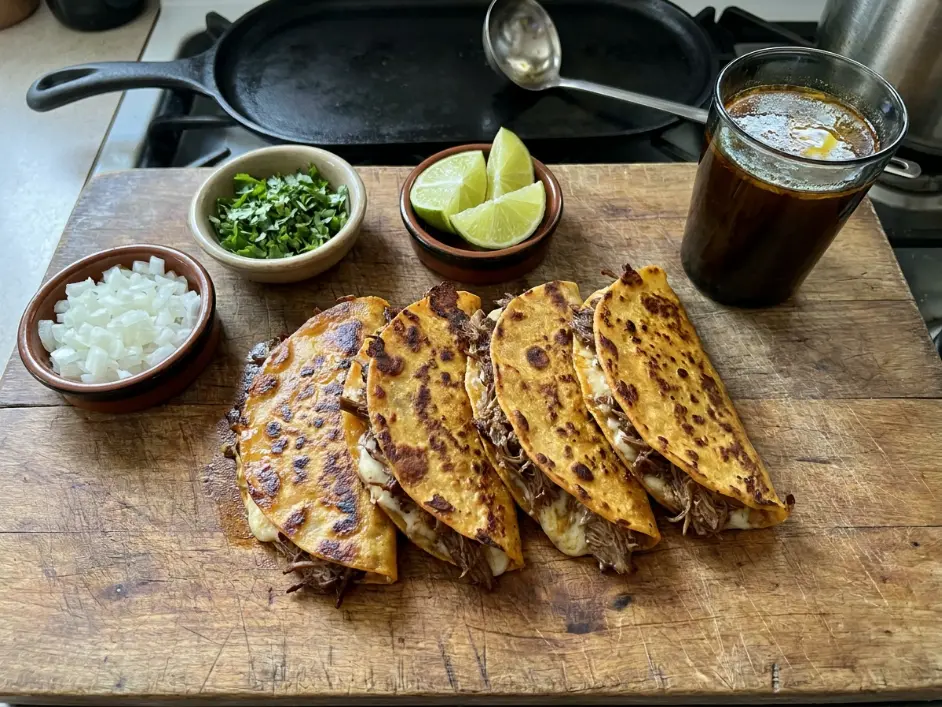
Serve immediately alongside small bowls of the reserved warm consommé (the aqueous broth layer you carefully avoided during dipping), finely diced white onion, chopped fresh cilantro, and lime wedges. The traditional eating method is to bite into the crispy taco, then dip the bitten edge into the consommé before taking the next bite—this allows you to add moisture and flavor exactly where you want it without compromising the structural integrity of the unbitten portions.
Chef Albert’s Insight
Birria tacos represent one of the most sophisticated applications of kitchen physics I have encountered in street food. What appears to be a simple fried taco is actually a carefully orchestrated sequence of phase separations, moisture controls, and thermal transformations. Each component must be prepared with precision, each step executed in the correct order, or the entire system fails.
The beauty lies in how invisible these techniques are to the diner. They taste richness, crunch, spice, and satisfaction—they do not think about lipid stratification or starch retrogradation. But as cooks, we must think about these things. We must understand that the orange-red oil floating on our broth is not waste to be skimmed away but rather the key ingredient that makes crispness possible.
This is the quiet contract between science and craft: we study the invisible forces so that others may enjoy the visible results. That is the privilege and responsibility of the serious cook.
— Chef Albert, TastePillar
Pro Shopping Guide: USA-Specific Sourcing for Maximum Impact
Your ingredient and equipment choices directly determine whether the fat separation and crisping physics succeed. Here is how to source optimally in the United States market.
For beef: Chuck roast is the gold standard for birria—it contains 20-25% fat and abundant connective tissue that breaks down into gelatin during braising. Look for USDA Choice or Prime grade for best marbling. Whole Foods, Costco, and Kroger meat departments consistently stock quality chuck. Short ribs are an excellent alternative with even higher fat content (25-30%), though more expensive. Avoid pre-cut “stew meat” which is often lean round or sirloin.
For dried chilies: Guajillo and ancho chilies are essential and increasingly available in mainstream supermarkets. Melissa’s brand (sold at Kroger, Safeway, Albertsons) packages them in convenient 3-4 chile pouches. For bulk purchasing and better quality, visit a Mexican grocery store like Northgate Market, El Super, or Cardenas—you will find huge bags for a fraction of the price. The chilies should be pliable, not brittle and crumbling (indicating age).
For tortillas: Fresh corn tortillas from a tortillería are vastly superior to supermarket packages. In areas with significant Mexican populations, look for tortilla factories that produce daily—they sell warm tortillas by the dozen or kilo. If using packaged tortillas, Guerrero brand (yellow or white corn, not flour) is widely available and acceptable. Maria & Ricardo’s brand (sold at Whole Foods, some Targets) is premium quality. Avoid “low-carb” or flavored tortillas—you need pure nixtamalized corn.
For Oaxaca cheese: This stringy, mild melting cheese is the traditional choice. Cacique brand (available at most major supermarkets) produces authentic Oaxaca in various sizes. V&V Supremo is another reliable brand. If unavailable, whole milk low-moisture mozzarella (not fresh) is an acceptable substitute—Galbani or Belgioioso brands work well. Monterey Jack is the easiest-to-find alternative and performs nearly identically to Oaxaca.
For beef bone broth: Homemade is ideal, but store-bought works for this application. Pacific Foods Organic Beef Bone Broth (sold at Target, Whole Foods, most grocery stores) has rich flavor and good gelatin content. Kettle & Fire Beef Bone Broth (often sold on Amazon, Thrive Market) is also excellent. Avoid standard beef stock or bouillon—you need the collagen richness of true bone broth.
For the plancha/griddle: A heavy cast-iron flat griddle is essential for proper heat retention and even cooking. Lodge Pre-Seasoned Cast Iron Griddle (reversible, around $30-40 at Walmart, Target, Amazon) is the budget champion. It fits over two burners and provides ample cooking surface. For premium quality, Victoria Cast Iron Comal (Mexican-made, around $25-35 at specialty stores or Amazon) is specifically designed for tortilla cooking and has ideal thickness.
For the Dutch oven: You need heavy construction for even braising heat. Lodge Enameled Cast Iron Dutch Oven (6-quart, around $60-80) performs identically to Le Creuset at one-third the price. Cuisinart Cast Iron Casserole is another solid mid-price option.
For tools: A wide, flat ladle with a shallow bowl is perfect for fat skimming—OXO Good Grips Ladle works well. A fish spatula (thin, slotted metal) is ideal for flipping tacos without tearing—Mercer Culinary or Winco brands are professional quality at reasonable prices.
Complete Ingredient Breakdown: US Customary & Metric
| Ingredient Category | Item | US Customary | Metric |
|---|---|---|---|
| Braised Beef & Broth | Beef chuck roast or short ribs (chunks) | 3 lbs | 1.36 kg |
| Dried guajillo chilies (stemmed, seeded) | 4 chilies | 4 chilies | |
| Dried ancho chilies (stemmed, seeded) | 2 chilies | 2 chilies | |
| White onion (halved) | 1 medium | 150g | |
| Garlic cloves (peeled) | 6 cloves | 20g | |
| Beef bone broth | 4 cups | 950ml | |
| Mexican oregano | 1 tsp | 3g | |
| Ground cumin | 1 tsp | 3g | |
| Ground cinnamon | ½ tsp | 1g | |
| Kosher salt | 2 tsp | 12g | |
| Black pepper | 1 tsp | 3g | |
| Taco Assembly | Premium yellow corn tortillas | 12 tortillas | 12 tortillas |
| Oaxaca or Monterey Jack cheese (shredded) | 3 cups | 300g | |
| White onion (finely diced) | 1 cup | 150g | |
| Fresh cilantro (finely chopped) | ½ cup | 20g | |
| Limes (cut into wedges) | 3 large | 3 large |
Common Mistakes Table: What Destroys Your Taco Crispness (And How to Prevent It)
| The Mistake | What Actually Happens | The Fix |
|---|---|---|
| Dipping tortilla deep into mixed broth instead of fat cap only | Tortilla absorbs 340% its weight in water; starch hydrates; impossible to crisp; structural collapse | Skim surface fat layer carefully; dip tortilla horizontally across top oil only; avoid breaking into aqueous layer below |
| Using lean beef cuts (sirloin, round) | Insufficient fat renders during braise; no fat cap forms; cannot achieve proper lipid coating | Always use chuck roast, short ribs, or beef shank—minimum 20% fat content |
| Griddle temperature too low (below 350°F) | Slow dehydration allows moisture penetration; tortilla steams rather than fries; remains pale and soft | Preheat griddle to exactly 400°F; verify with infrared thermometer before cooking |
| Adding wet, un-drained shredded beef | Excess moisture saturates tortilla from inside; steam prevents crisping; cheese layer overwhelmed | Drain shredded beef in fine-mesh strainer for 5+ minutes; press gently to remove liquid; meat should glisten but not drip |
| Using high-moisture fresh mozzarella or queso fresco | Cheese releases excessive water during melting; liquid saturates tortilla; crispy texture impossible | Use only low-moisture Oaxaca or Monterey Jack cheese; avoid fresh cheeses entirely |
| Skipping the compression press after folding | Air pockets remain between layers; uneven heat transfer; soft spots develop; filling slides out | Press firmly with metal spatula for 15 seconds after folding; forces out air and ensures tortilla-griddle contact |
| Draining finished tacos on paper towels | Trapped steam condenses on bottom surface; instant sogginess; crispy texture destroyed within seconds | Always drain on elevated wire rack; air circulation on all surfaces preserves crispness |
Step-by-Step Method: The Complete Engineering Process
Step 1: Execute the Beef Braise and Chili Infusion
Pat beef chunks completely dry with paper towels. Season aggressively with kosher salt and black pepper. Heat a large Dutch oven over high heat until a drop of water evaporates instantly. Add beef chunks in a single layer (work in batches if needed—do not crowd). Sear without moving for 4-5 minutes per side until a deep mahogany crust forms through Maillard reactions. Transfer seared beef to a plate.
Reduce heat to medium. Add dried guajillo chilies, ancho chilies, halved white onion (cut-side down), and whole peeled garlic cloves to the remaining beef fat in the pot. Toast for 2-3 minutes, stirring occasionally, until chilies are fragrant and slightly darkened. The toasting releases volatile aromatic compounds and begins breaking down the chili cell walls.
Add beef bone broth, Mexican oregano, cumin, and cinnamon. Bring to a simmer and cook for 10 minutes to fully hydrate and soften the dried chilies. Transfer the chili-broth mixture (including softened chilies, onion, and garlic) to a high-powered blender. Blend on high speed for 90 seconds until completely smooth—the mixture should be uniform with no visible chili skin fragments.
Strain the blended mixture through a fine-mesh sieve back into the Dutch oven, pressing on the solids to extract maximum liquid. Discard the fibrous solids. Return the seared beef chunks to the strained liquid. The liquid should come about three-quarters of the way up the meat.
Cover the Dutch oven with a tight-fitting lid. Transfer to a preheated 300°F (150°C) oven. Braise for 3 hours without opening the lid. The beef is done when it shreds effortlessly with a fork—internal temperature should read 200-205°F (93-96°C).
Step 2: Execute Critical Fat Stratification and Beef Preparation
Remove the Dutch oven from the oven. Transfer the beef chunks to a large bowl using a slotted spoon. Let the beef cool for 10 minutes, then shred into bite-sized pieces using two forks or your hands. Transfer the shredded beef to a fine-mesh strainer set over a bowl. Let drain for 5 minutes, pressing occasionally to expel excess liquid.
Meanwhile, let the remaining liquid in the Dutch oven sit completely undisturbed for 5 minutes. Watch as the low-density orange-red fat naturally rises to the surface, forming a distinct layer 3-8mm thick depending on your beef’s fat content. Do not stir, swirl, or disturb this liquid in any way.
Using a wide, flat ladle, carefully skim the fat cap from the surface and transfer it to a small bowl—this is your precious dipping oil. Set aside. The remaining darker liquid below is your consommé for serving alongside the tacos. Keep it warm over very low heat.
Step 3: Prepare the High-Temperature Griddle Surface
Place a heavy cast-iron griddle or plancha across two burners. Heat over medium-high heat for 8-10 minutes until the surface reaches exactly 400°F (204°C)—verify with an infrared thermometer. The griddle must be evenly heated across its entire surface for consistent results.
Have your assembly station organized: bowl of skimmed fat, plate of corn tortillas, bowl of shredded drained beef, bowl of shredded Oaxaca cheese, metal spatula, tongs, and wire cooling rack ready.
Step 4: Execute the Precision Fat-Coating Dip
Hold one corn tortilla horizontally by opposite edges. Lower it flat onto the surface of the skimmed fat layer in your bowl. Press very gently—the tortilla should make contact with the fat but should not sink or fold. Drag the tortilla across the fat surface, allowing it to pick up a thin coating. Lift straight up.
Flip the tortilla and repeat the process on the second side. The tortilla should emerge glistening and deep orange-red but not dripping or heavy. If fat is dripping off the edges, you have picked up too much—gently shake excess back into the bowl.
Immediately place the fat-coated tortilla onto the preheated griddle. It should sizzle aggressively on contact. Wait exactly 30 seconds without touching it.
Step 5: Assemble, Fold, and Execute Final Compression Sear
After 30 seconds, scatter approximately ¼ cup shredded Oaxaca cheese across the entire tortilla surface while it continues to cook on the griddle. The cheese will begin melting immediately from the heat rising through the tortilla.
Place 2 tablespoons of drained shredded beef onto one half of the cheese-covered tortilla, forming a horizontal line of meat.
After another 30-60 seconds (total cooking time 60-90 seconds for the first side), use a metal spatula to fold the empty half of the tortilla over the beef-filled half, creating a half-moon shape. Align the edges as precisely as possible.
Immediately press down firmly on the folded taco with the flat surface of the spatula. Hold firm pressure for 15 seconds. You should hear vigorous sizzling and see steam escaping from the edges—this is air and residual moisture being expelled. Release pressure.
Cook for an additional 60-90 seconds on this side, watching for deep red-orange color with visible blistering and dark spots. Carefully flip the taco to the opposite side using the spatula. Cook for another 60-90 seconds until both sides show uniform blistering, deep color, and crispy texture.
Transfer the finished taco to a wire cooling rack. Repeat the process for all remaining tortillas.
Serve immediately with warm consommé in small bowls, finely diced white onion, chopped fresh cilantro, and lime wedges on the side.
Nutrition Information (Per Taco, Based on 12 Servings)
| Nutrient | Amount |
|---|---|
| Calories | 340 kcal |
| Protein | 24g |
| Total Fat | 20g |
| Saturated Fat | 9g |
| Total Carbohydrates | 18g |
| Dietary Fiber | 3g |
| Sugars | 1g |
| Cholesterol | 75mg |
| Sodium | 580mg |
| Calcium | 18% DV |
| Iron | 15% DV |
| Vitamin C | 8% DV |
Note: Nutrition values are estimates based on USDA databases. Actual values will vary depending on specific beef cut used, amount of fat absorbed during dipping, and cheese quantity.
USDA Food Safety Temperature Guide
| Critical Temperature Point | Temperature | Safety/Quality Purpose |
|---|---|---|
| Danger zone (bacterial growth) | 40°F – 140°F / 4°C – 60°C | Braised beef should not remain in this range for more than 2 hours |
| Beef safe minimum braising temp | 200°F – 205°F / 93°C – 96°C | Ensures collagen conversion to gelatin; fork-tender texture |
| Braising oven temperature | 300°F / 150°C | Low, slow heat for even collagen breakdown without drying |
| Optimal griddle surface temp | 400°F / 204°C | Rapid surface dehydration; Maillard browning; prevents scorching |
| Cheese melting point (Oaxaca) | 130°F – 140°F / 54°C – 60°C | Casein proteins denature; fats liquefy; creates moisture barrier |
| Consommé serving temperature | 160°F – 180°F / 71°C – 82°C | Hot enough for flavor release; safe for dipping without scalding |
| Maximum taco crispness window | 3-5 minutes post-cooking | Optimal texture preservation before starch retrogradation begins |
Storage & Reheating: Preserving Taco Integrity
| Storage State | Refrigerator (≤40°F) | Freezer (0°F) | Best Reheating Method |
|---|---|---|---|
| Braised beef (shredded, drained) | 4 days in airtight container | 3 months in freezer-safe bag | Reheat gently in skillet with 2 tbsp consommé until warm |
| Separated consommé (aqueous layer) | 5 days in sealed jar | 4 months in freezer container | Reheat in saucepan to 170°F; fat will re-separate naturally |
| Separated fat cap (dipping oil) | 7 days in sealed jar (will solidify) | 6 months in freezer container | Gently warm until liquefied; stir before using |
| Assembled crispy tacos | Not recommended (texture destroyed) | Not recommended | Consume immediately for optimal crispness |
| Un-cooked fat-coated tortillas | Not safe—must cook immediately | N/A | Cook within 2 minutes of dipping to prevent spoilage |
Critical storage note: The crispy texture of finished tacos cannot be preserved through refrigeration or reheating. The starch retrogradation that creates crispness reverses when exposed to moisture and cooling. Always prepare tacos fresh to order.
Make-ahead strategy: Braise beef up to 3 days ahead. Store shredded beef and separated consommé/fat cap in separate containers. Reheat gently before assembly. The actual dipping, assembling, and griddle-crisping should always be done immediately before serving.
FAQ: Your Birria Taco Questions Answered
Why is my fat cap not forming?
Insufficient fat in your beef cut is the primary cause. Chuck roast should contain visible marbling and fat seams. If using a lean cut by mistake, you can supplement by adding 2-3 tablespoons of lard or beef tallow to the braising liquid. Also ensure you are letting the liquid rest completely undisturbed for at least 5 minutes—any movement prevents fat coalescence.
Can I use flour tortillas instead of corn?
Structurally, yes, but the result will be different. Flour tortillas contain gluten which creates a chewy rather than crispy texture when fried. They also lack the distinctive corn flavor and will not develop the same blistered appearance. If you must use flour, reduce cooking time by about 30% to prevent toughness.
My tortillas are tearing when I dip them—what am I doing wrong?
This indicates either stale, dried-out tortillas or too much pressure during dipping. Ensure your tortillas are fresh and pliable. If using packaged tortillas, warm them slightly (30 seconds in microwave wrapped in damp towel) before dipping. Dip with minimal pressure—you are coating, not submerging.
How do I prevent the beef from sliding out when I fold?
This occurs when the cheese layer is insufficient or the beef is piled too high. Use a full ¼ cup of cheese spread across the entire tortilla, and limit beef to 2 tablespoons per taco. The cheese must fully melt and surround the beef before folding. Also ensure you are pressing firmly after folding to compress the filling.
Can I make these in advance for a party?
Not successfully. The crispy texture degrades rapidly—within 10-15 minutes. For parties, pre-braise the beef, shred and drain it, separate your fat cap, and have all components ready. Set up a griddle station and cook tacos to order in batches of 3-4. Guests can wait 2 minutes for fresh crispy tacos—it is worth it.
Related Articles on TastePillar
5 Rules for the Ultimate Restaurant-Style Salsa Roja: The Charred Tomatillo Pectin Secret The Ultimate Butter Chicken Smash Burgers: 3 Tricks for the Juiciest Fusion Patty
Sheet Pan Steak Fajitas: A Gourmet Mexican Dinner with Zero Cleanup
Ultimate Birria Ramen: 5 Scientific Secrets to Perfect Consommé Emulsion
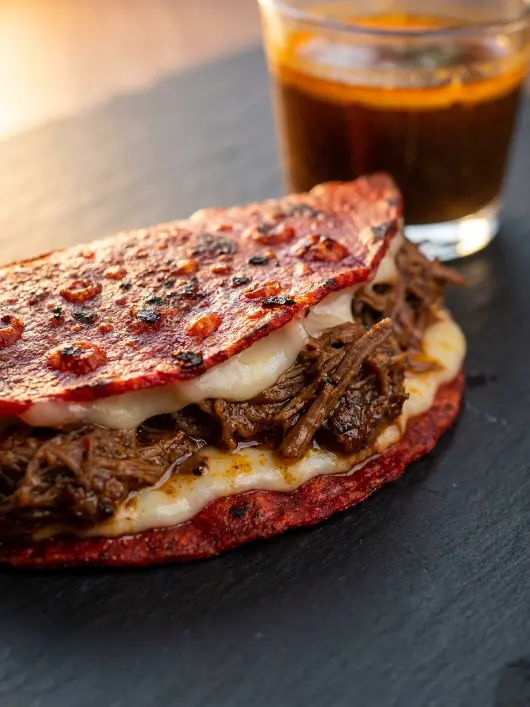
The Crispiest Birria Tacos (Fat-Cap Dipping Science Edition)
Ingredients
Equipment
Method
- The Sear & Chili Steep: Pat beef chunks dry. Season with salt and pepper. Sear in hot Dutch oven 4-5 minutes per side until deep brown crust forms. Remove beef. Add dried chilies, halved onion (cut-side down), and garlic to remaining fat. Toast 2-3 minutes until fragrant. Add bone broth and spices. Simmer 10 minutes to soften chilies.
- The Puree Base: Transfer chili-broth mixture (including softened chilies, onion, garlic) to blender. Blend 90 seconds until completely smooth. Strain through fine-mesh sieve back into Dutch oven, pressing solids. Discard fibrous material. Return seared beef to strained liquid.
- The Braise: Cover Dutch oven with tight lid. Transfer to preheated 300°F (150°C) oven. Braise 3 hours without opening until beef shreds easily (internal temp 200-205°F / 93-96°C).
- The Lipid Separation: Remove beef chunks to bowl. Let cool 10 minutes, then shred with forks. Transfer to fine-mesh strainer over bowl. Drain 5 minutes, pressing occasionally. Meanwhile, let braising liquid sit undisturbed 5 minutes. Orange-red fat cap will rise to surface. Using wide ladle, carefully skim fat cap into small bowl (dipping oil). Keep remaining consommé warm over low heat.
- The Critical Dip: Heat cast-iron griddle to 400°F (204°C). Hold one corn tortilla horizontally. Lay flat on surface of skimmed fat, press gently, drag to coat. Lift straight up. Flip and repeat. Tortilla should glisten orange-red but not drip.
- The Plancha Crisp: Place fat-coated tortilla on griddle (should sizzle immediately). Wait 30 seconds. Scatter ¼ cup shredded cheese across entire tortilla surface. Add 2 tbsp drained beef to one half. After 60-90 seconds total first-side cooking, fold empty half over beef half using spatula.
- Fold and Seal: Immediately press folded taco firmly with spatula for 15 seconds to expel air and steam. Cook 60-90 seconds per side until both sides show deep red-orange color with blistering. Transfer to wire rack. Repeat for all tortillas.
- Serve: Serve immediately with warm consommé in small bowls, diced onion, cilantro, and lime wedges.
Notes
- Never dip tortilla deep into mixed broth—only skim the separated fat cap on surface.
- Griddle temperature is critical—too low produces soggy tacos, too high scorches them.
- Drained beef should glisten but not drip before adding to tortillas.
- Crispy texture is best within 5 minutes of cooking; do not make ahead.