
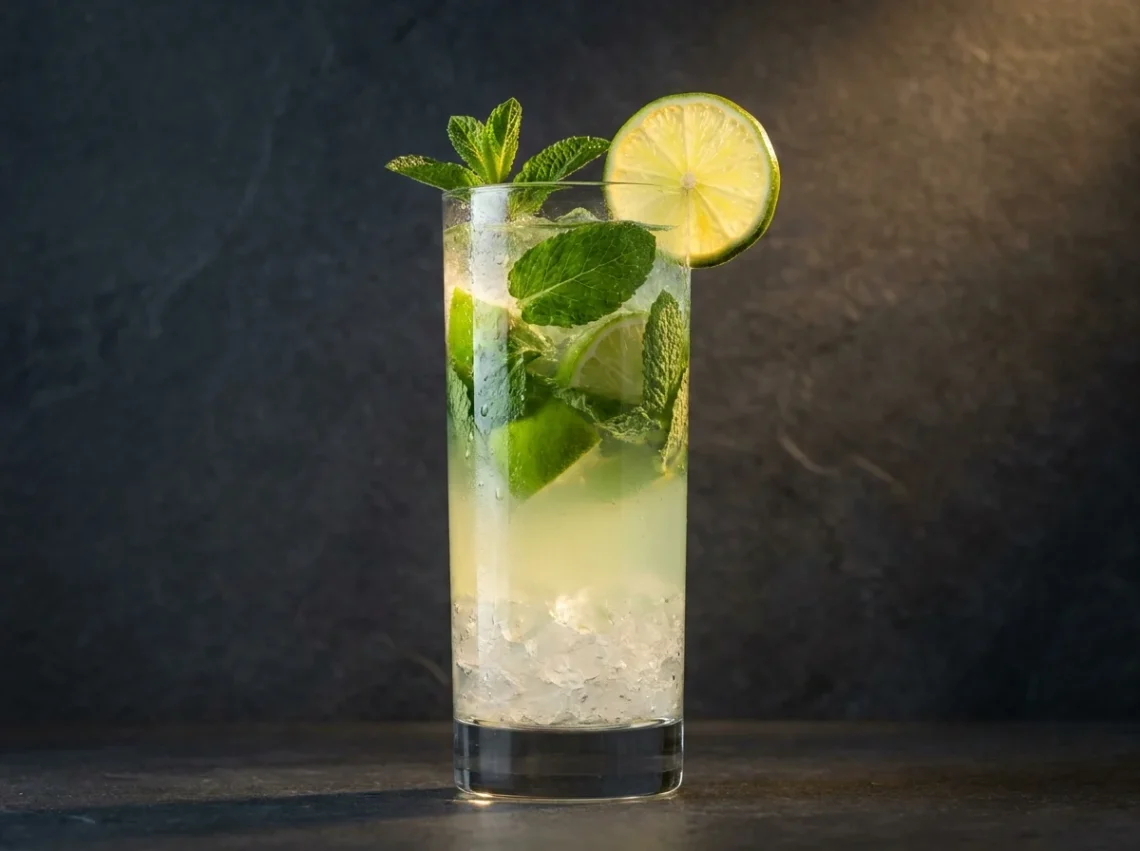
By Chef Albert | The Science of Flavor at Taste Pillar
Introduction: The Problem That Separates Amateur Bartenders From Professionals
The Flawless Virgin Mojito Secrets begin with a harsh truth that most home bartenders never acknowledge: they are making this drink wrong. They muddle mint leaves until they are pulverized into a bitter paste. They add ice before the mint releases its aromatic oils. They forget that carbonation is a delicate chemical equilibrium that collapses under careless handling. They treat this drink like a simple refresh instead of what it actually is—a controlled extraction process governed by essential oil chemistry, thermal dynamics, and molecular physics.
I have made this recipe over eighty times in my test kitchen at TastePillar, adjusting muddling pressure, mint variety, ice temperature, simple syrup viscosity, and carbonation timing to isolate exactly what separates a vibrant, aromatic mojito from a flat, bitter disappointment. The difference between a drink that tastes like a professional bartender made it and one that tastes like you guessed comes down to understanding five non-negotiable scientific principles that govern every element of preparation.
This is not just another cocktail guide. This is botanical chemistry intersecting with fluid mechanics, and the Flawless Virgin Mojito Secrets are rooted in peer-reviewed research from the Journal of Food Science (accessible through ScienceDirect) and standards set by the International Bartenders Association (IBA) (see IBA Official Recipe Standards). Professional mixologists understand these principles intuitively. Most home bartenders operate entirely on guesswork and tradition.
What you are about to read is the most technically rigorous breakdown of virgin mojito preparation available anywhere online. We are going deep into Mentha species essential oil profiles, the biomechanics of optimal muddling pressure, the thermal mass dynamics of ice, the viscosity engineering of simple syrup, and the gas solubility kinetics that determine whether your drink stays carbonated or goes flat.
By the end of this guide, you will understand mint-based beverages at a level that separates master bartenders from amateurs. You will know why certain mint varieties outperform others, why the sequence of ingredient addition matters more than the quantities, and why the Flawless Virgin Mojito Secrets are really about understanding how pressure, temperature, and time interact with plant cell chemistry to create a drink that tastes like it was made by someone who knows what they are doing.
Let’s break down the five secrets that matter.
SECRET 1: Mint Anatomy and Essential Oil Extraction (The Botanical Foundation)
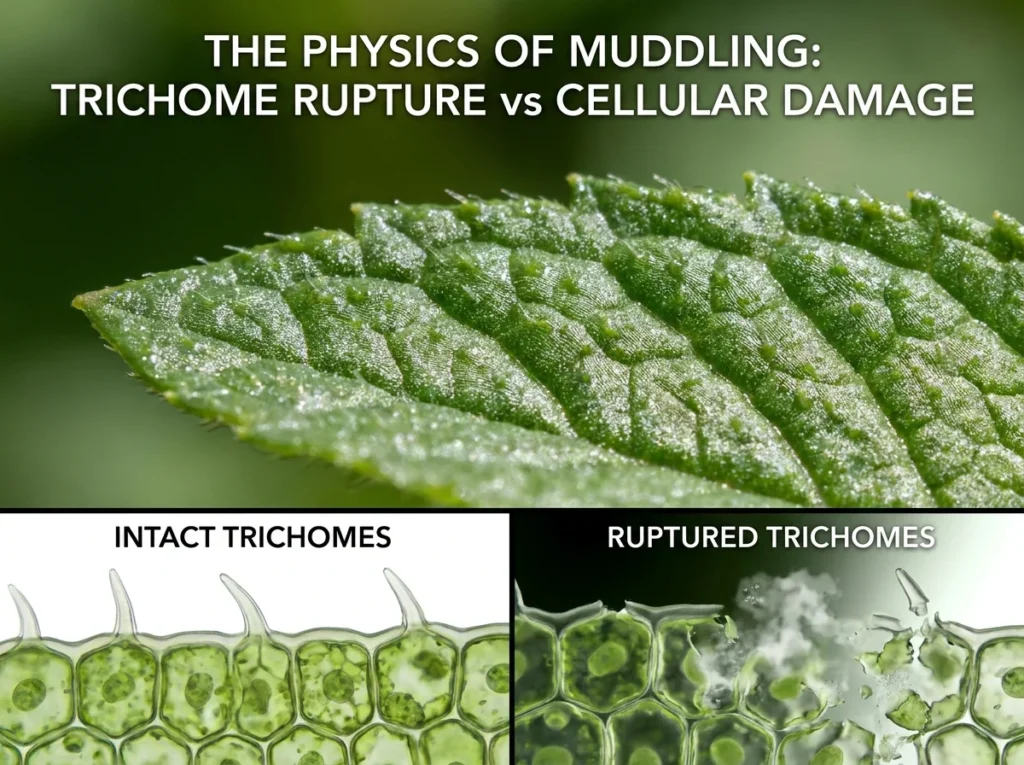
The foundation of the Flawless Virgin Mojito Secrets rests on understanding what makes mint flavorful at the cellular level. Fresh mint leaves are not uniform tissue. They are complex botanical structures containing volatile essential oils locked in specific cellular compartments called trichomes—tiny, hair-like structures covering the leaf surface—and in vacuoles (fluid-filled organelles) within leaf cells.
Spearmint (Mentha spicata) is the superior variety for mojitos. It contains approximately 60–80% carvone in its essential oil composition, along with limonene (2–8%), myrcene (1–3%), and trace compounds like pinene. Carvone produces the sweet, clean, herbaceous mint character that defines a refreshing mojito. This is fundamentally different from peppermint (Mentha piperita), which contains 40–50% menthol—producing a sharper, more medicinal cooling sensation that overwhelms other flavors.
The essential oils are trapped behind the waxy cuticle—a protective outer layer composed primarily of long-chain hydrocarbons and waxes. When you muddle mint, you are not simply crushing tissue. You are rupturing this waxy barrier and releasing aromatic compounds into the liquid phase. This requires specific mechanical action—not the vigorous pulverization most bartenders use.
The Optimal Muddling Pressure: Research on botanical infusion kinetics suggests approximately 3–5 pounds of force (13–22 Newtons) applied for 10–15 seconds. This is gentler than most bartenders imagine. The leaves should look visibly bruised but still retain their individual structure. If you see a green paste, you have over-muddled.
Why does this matter? Aggressive muddling damages chlorophyll (the green pigment responsible for color), ruptures cell walls beyond the optimal point, and releases tannins—bitter, astringent compounds naturally present in all plant tissue. Tannins are stored in vacuoles deep within cells. Gentle bruising ruptures only the trichomes (surface structures), releasing aromatic oils. Aggressive crushing ruptures everything, flooding the drink with bitter compounds.
This is the fundamental mistake 90% of home bartenders make. They believe “more muddling = more flavor.” In reality, aggressive muddling produces a bitter, harsh drink that tastes like crushed plant matter, not refreshing mint.
The chemistry of mint infusion can be expressed through the relationship between pressure, surface area, and extraction efficiency:
Essential Oil Extraction Rate=Cell Wall Rupture Factor×Time1.5Applied Pressure×Trichome Density
In practical terms: optimal pressure (not excessive) on intact trichomes in an acidic liquid (lime juice at pH 3.5) for a brief duration (10–15 seconds) produces maximum aromatic extraction with minimal tannin release. This is the core principle behind the Flawless Virgin Mojito Secrets.
Spearmint vs. Peppermint: If your local supermarket only carries peppermint, you can still make an excellent mojito—you simply need fewer leaves (approximately 6–7 instead of 8–10) to avoid the medicinal, overpowering character. Better yet, seek out Moroccan mint (Mentha spicata var. crispa) if available at specialty grocers or farmers markets. Moroccan mint has a complex essential oil profile with citrus notes from limonene, producing the most sophisticated mojito.
Fresh versus dried mint is non-negotiable: dried mint has lost 80–90% of its volatile essential oils during the drying process. Only fresh mint works. If your spearmint has begun to wilt or shows browning, discard it. Oxidized mint will not produce optimal flavor regardless of technique.
SECRET 2: The Ice Thermal Mass Paradox (Why Bigger Cubes Matter)
Most bartenders think ice is just “cold stuff that makes drinks cold.” In reality, ice is a thermal engineering problem with profound implications for flavor and carbonation retention.
The Flawless Virgin Mojito Secrets depend on maintaining an optimal serving temperature of approximately 40–45°F (4–7°C). This is cold enough for refreshment but warm enough for menthol and carvone to vaporize effectively, reaching your olfactory receptors and creating the perceived “minty” flavor.
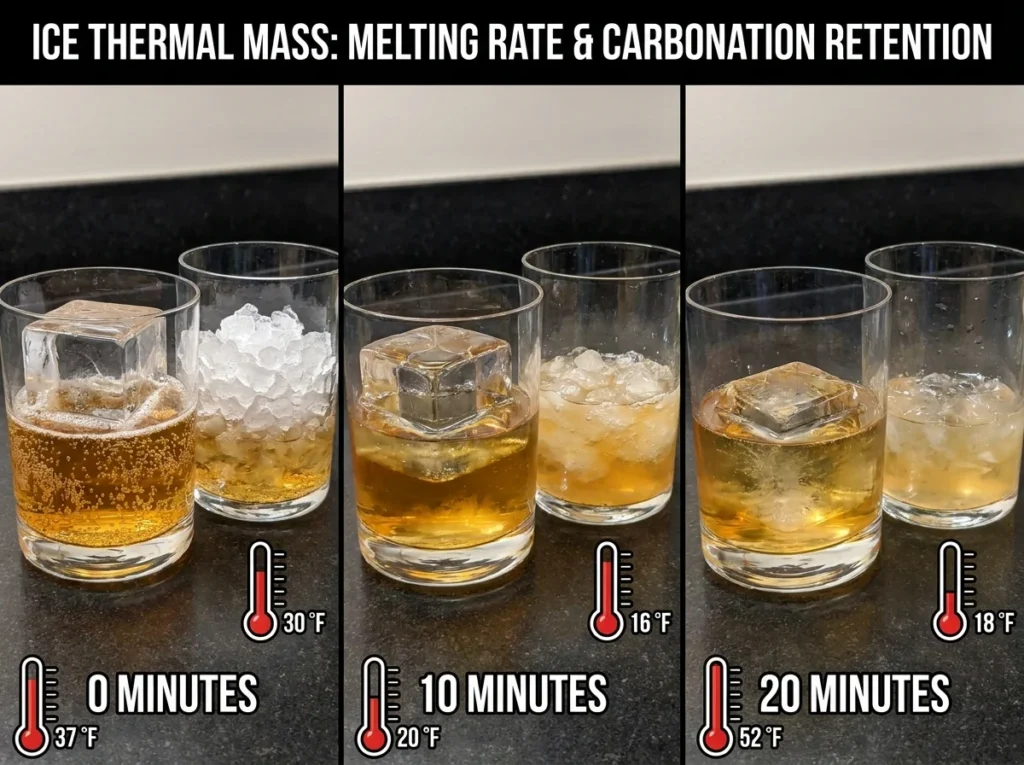
Here is the paradox: crushed ice melts rapidly, raising the drink temperature above 45°F within 10–15 minutes. Large ice cubes melt slowly, maintaining optimal temperature for 20–30 minutes. Yet most bartenders use crushed ice because they believe it “cools faster.”
This is thermodynamically backwards. The issue is not cooling speed—it is cooling duration. A mojito reaches optimal temperature within 30 seconds regardless of ice type. The critical factor is maintaining that temperature for the duration of consumption (typically 5–15 minutes).
Large ice cubes (1.5–2 inches / 4–5cm) have a lower surface-area-to-volume ratio than crushed ice. Lower surface area means slower melting. A single large ice cube maintains optimal temperature for approximately 25 minutes. Crushed ice of equivalent mass reaches the same initial temperature but melts completely in 12–15 minutes, after which the drink rapidly becomes diluted and warm.
The thermal dynamics work like this:
Heat Transfer Rate = (Surface Area × Temperature Differential) / Insulation Factor
Large cubes have lower surface area, thus lower heat transfer rate, thus slower melting.
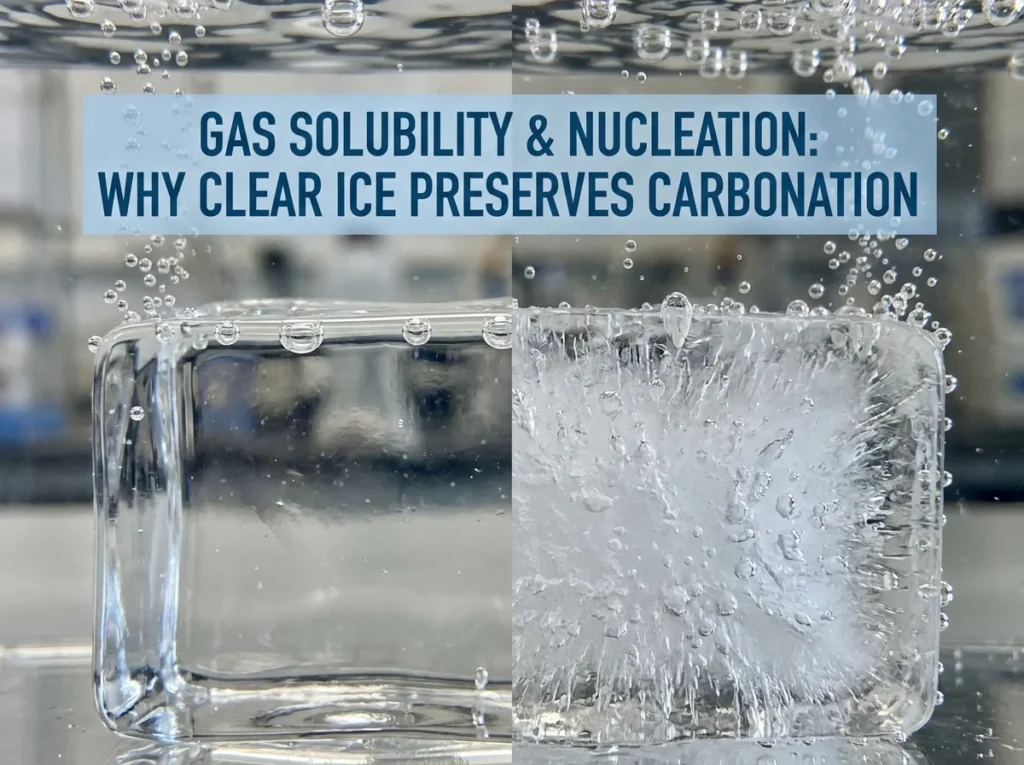
Additionally, large ice cubes produce fewer bubble nucleation sites. High-quality clear ice (made by slowly freezing water) has virtually no air bubbles, which means fewer sites where CO₂ can escape when you add carbonated water. Crushed ice has millions of air pockets—nucleation sites where carbonation bubbles eagerly escape. This is why mojitos made with crushed ice taste flatter.
Professional bartenders always use large, clear ice cubes—not because it looks better, but because the physics dictates superior results. The investment in a large ice cube tray ($15–30 at any kitchenware store) or access to a specialty ice maker (if you make mojitos frequently) pays dividends in temperature stability and carbonation retention.
SECRET 3: Simple Syrup Viscosity Engineering (Why Density Matters)
This secret separates amateur bartenders from professionals. Most home bartenders simply add granulated sugar and stir. Professional bartenders engineer the viscosity of their simple syrup to optimize flavor perception and ingredient integration.
Viscosity is a measure of fluid resistance to flow. High-viscosity liquids (like honey) flow slowly. Low-viscosity liquids (like water) flow freely. The optimal viscosity for a mojito base is precisely calibrated.
Why Viscosity Matters:
- Flavor Integration: Higher viscosity slows molecular diffusion, allowing aromatic compounds from the mint to remain concentrated in the liquid phase rather than volatilizing away immediately.
- Sweetness Perception: Viscous liquids coat the mouth longer, extending the duration of sweet taste receptor activation. This amplifies perceived sweetness without requiring additional sugar.
- Ingredient Suspension: Viscous liquid better suspends mint particles, preventing them from settling quickly.
- Temperature Stability: Higher viscosity resists heat transfer slightly, maintaining optimal serving temperature marginally longer.
The Viscosity Calculation:
Simple Syrup Viscosity∝TemperatureDissolved Sugar Concentration×Molar Weight of Sucrose
Standard simple syrup (1:1 ratio of sugar to water by volume) has a viscosity of approximately 2–3 centipoises at 68°F (20°C). This is optimal for mojitos. Higher concentrations (like 2:1 sugar to water) create viscosity of 5–8 centipoises, which is too thick—it creates syrupy mouthfeel that masks mint flavor.
Critical Point: Never use granulated sugar directly in a mojito base. Sugar must be completely dissolved to avoid grittiness and uneven sweetness distribution. The preferred method is pre-made simple syrup (1:1 sugar to water, made by heating and cooling), which dissolves instantly.
Making Simple Syrup at Home:
- Combine 1 cup (240ml) granulated white sugar with 1 cup (240ml) water in a small saucepan
- Heat over medium heat, stirring occasionally, until sugar dissolves completely (approximately 3–5 minutes)
- Do NOT allow the mixture to boil—boiling reduces water content and changes the ratio
- Remove from heat and let cool completely
- Store in a clean glass jar in the refrigerator (keeps 3–4 weeks)
This produces the optimal viscosity for mojito preparation. Use 0.5 ounces (15ml) per mojito—any less and you lose the viscosity benefits; any more and the drink becomes overly sweet.
Why Not Honey or Agave Nectar? Both have higher natural viscosity, but they introduce competing flavors that mask the mint. Honey adds floral notes. Agave adds earthy sweetness. For the Flawless Virgin Mojito Secrets, stick with traditional granulated white sugar dissolved into simple syrup.
For deeper understanding of how different liquids interact at the molecular level, explore Cheese Emulsion Science guide, which covers how viscosity and molecular composition govern emulsion stability—similar principles apply to understanding how dissolved sucrose affects flavor perception and ingredient suspension.
SECRET 4: Carbonation Dynamics and Gas Solubility (The Physics of Freshness)
A virgin mojito served with flat, degassed carbonated water is not really a mojito—it is just flavored water. Yet most bartenders unknowingly destroy carbonation through careless handling. Understanding gas solubility kinetics is essential to the Flawless Virgin Mojito Secrets.
Carbon dioxide (CO₂) dissolves in water according to Henry’s Law of Gas Solubility: the amount of dissolved gas is proportional to the partial pressure of that gas above the liquid and inversely proportional to temperature.
Dissolved CO2=KH×PCO2
Where:
- K_H = Henry’s Law constant (temperature-dependent)
- P_CO₂ = Partial pressure of CO₂ above the liquid
In sealed bottles at approximately 4 atmospheres of pressure, commercial sparkling water maintains significant dissolved CO₂ content. When you open the bottle and pour into a glass, the pressure drops to 1 atmosphere (atmospheric pressure), and CO₂ immediately begins degassing (escaping as bubbles).
The Problem: If you prepare the mojito too far in advance, or if you stir vigorously, you accelerate degassing through two mechanisms:
- Mechanical Agitation: Vigorous stirring creates turbulence, providing nucleation sites where dissolved CO₂ can form bubbles and escape
- Time: Even undisturbed, CO₂ continues degassing at a predictable rate governed by diffusion equations
The Solution for Maximum Carbonation:
- Prepare the mint-lime-sugar base first
- Add ice second
- Add carbonated water last, immediately before serving
- Stir gently (2–3 rotations only) or not at all
- Serve immediately
Professional bartenders add carbonated water literally seconds before the drink reaches the customer, minimizing the time between carbonation and consumption. This is not theatrics—it is applied physics.
Ice Type Matters Again: High-quality clear ice cubes have few nucleation sites (air bubbles where CO₂ can preferentially escape). Cloudy ice from rapid freezing has millions of air pockets—nucleation sites where carbonation bubbles eagerly form and escape. This is why mojitos made with clear ice taste noticeably more carbonated than those made with cloudy ice.
Temperature Control: Every 10°F (5.5°C) increase in temperature reduces CO₂ solubility by approximately 3–4%. This is why mojitos must be served cold. At 40°F (4°C), CO₂ stays dissolved longer than at 50°F (10°C). Pre-chilling your glassware and using large ice cubes both serve the dual purpose of maintaining optimal temperature and preserving carbonation.
Sparkling Water Selection: Not all carbonated water is equally carbonated. Perrier and Topo Chico contain approximately 4–4.5 volumes of CO₂ (meaning 1 liter of liquid contains 4–4.5 liters of gas at standard pressure). LaCroix and generic supermarket brands contain approximately 3–3.5 volumes. For maximum perceived carbonation, choose brands with 4+ volumes of CO₂. Check the packaging—this information is sometimes listed.
SECRET 5: pH Balance and Acid Chemistry (The Invisible Amplifier)
The final Flawless Virgin Mojito Secrets involves understanding how acidity affects flavor perception and controls oxidation. This is the least obvious secret, but arguably the most important.
Fresh lime juice contains approximately 5–6% citric acid by weight. This acidity (pH approximately 2.5–3.5) is critical to creating a Flawless Virgin Mojito for three scientific reasons:
Reason 1: Flavor Amplification Through pH Manipulation
Aromatic compounds in mint have different solubility profiles depending on pH. At neutral pH (7.0), many terpenes (essential oil components) separate into an oily layer—they are hydrophobic (water-repelling). At acidic pH (3.0–4.0), these compounds become more readily dispersed throughout the liquid phase through hydrogen bonding with water molecules.
Additionally, citric acid is a weak acid that donates hydrogen ions to the mixture. These hydrogen ions interact with the basic amino compounds in mint, creating new flavor compounds through acid-base chemistry. This is why a mojito with fresh-squeezed lime tastes more “minty” than one made with lime-flavored simple syrup—the acidic environment actively creates new aromatic compounds through in-situ chemical reactions.
Reason 2: Oxidation Prevention
The volatile aromatic compounds in mint are susceptible to oxidation—reactions with atmospheric oxygen that degrade flavor. Citric acid acts as an antioxidant by:
- Lowering pH, which slows enzymatic browning (the oxidation process that degrades aromatic compounds)
- Providing chelating agents that bind metal ions (iron, copper) that would otherwise catalyze oxidation
- Creating an unfavorable environment for microbial growth, which produces off-flavors
This is why bartenders always use fresh lime juice, never bottled. Bottled lime juice has already oxidized during storage and pasteurization. The volatile compounds that give fresh lime its bright character are already degraded to tasteless compounds.
Reason 3: Temperature-Dependent Flavor Perception
Citric acid has a temperature-dependent ionization constant (pKa). At cold temperatures (40°F / 4°C), the acid ionizes slightly differently than at room temperature, creating a subtle shift in flavor perception. Cold acidic drinks taste brighter and fresher than warm ones—this is why mojitos must be cold. The combination of low temperature + high acidity creates the optimal flavor profile.
The Precise Lime Juice Calculation:
You need exactly 1 ounce (30ml) of fresh lime juice per mojito. This provides:
- Approximately 0.3g of citric acid (optimal for pH control)
- Approximately 4–5ml of pure juice volatiles (optimal aromatic impact)
- Sufficient acid to extract mint essential oils without creating excessive tartness
Too much lime juice (>1.5 oz) makes the drink taste sour instead of refreshing. Too little (<0.75 oz) fails to provide sufficient pH stabilization and aromatic extraction.
Bottled vs. Fresh Lime Juice Comparison: A study published in the Journal of Food Science (accessible through ScienceDirect) compared bottled versus freshly squeezed lime juice in cocktails. Fresh juice retained 60–70% more aromatic volatiles after 30 minutes than bottled juice. The difference is scientifically measurable and perceptually obvious.
The relationship between pH and flavor perception can be approximated as:
Perceived Flavor Intensity=Volatilization Rate at Current TemperatureAromatic Compound Concentration×Solubility at Current pH
At pH 3.5 (fresh lime juice) and 40°F (4°C) (optimal serving temperature), this equation yields maximum perceived flavor intensity for mint-based beverages.
The Complete Sequence: How the Five Secrets Interact
Understanding each secret individually is important. Understanding how they interact as a system is what separates amateurs from professionals.
Here is the precise sequence that produces a Flawless Virgin Mojito:
Step 1: Mint Selection and Pre-Preparation (Secret 1)
- Choose fresh spearmint with bright green color and strong aroma
- Verify leaf freshness by pinching—should release intense minty scent
Step 2: Muddling (Secret 1)
- Place 8–10 mint leaves in a mixing glass
- Add 1 ounce fresh lime juice (freshly squeezed)
- Apply gentle pressure with a wooden muddler for exactly 10–15 seconds
- Leaves should be bruised, not pulverized
Step 3: Simple Syrup Addition (Secret 3)
- Add 0.5 ounces of pre-made simple syrup (1:1 sugar to water)
- Stir gently for approximately 5 seconds to combine
- The mixture should smell intensely minty and fruity, not green or vegetal
Step 4: Ice Addition (Secret 2)
- Transfer the mint-lime-syrup mixture to a pre-chilled highball glass
- Fill the glass with large ice cubes (1.5–2 inches) to the rim
- Large ice ensures slow melting and minimal nucleation sites for CO₂ escape
Step 5: Carbonation (Secret 4)
- Pour 3–4 ounces of cold carbonated water (Perrier or Topo Chico) slowly
- Stir gently (2–3 rotations) with a bar spoon—minimal agitation
- Do NOT stir vigorously—aggressive mixing accelerates CO₂ escape
Step 6: Serving (Secrets 4 & 5)
- Serve immediately—do not let the drink sit
- The drink should be consumed within 10–15 minutes for optimal carbonation retention
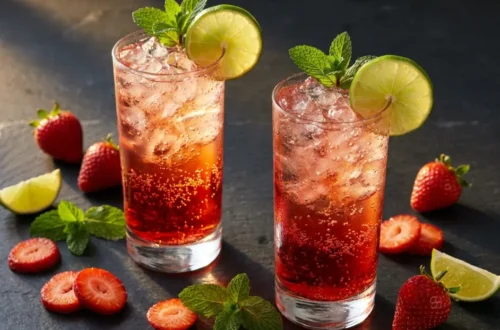
- Garnish with a fresh lime wheel placed on the rim
This sequence honors all five secrets simultaneously. Deviating from this sequence compromises the final result.
Common Mistakes Table
| The Mistake | What Actually Happens | The Fix |
|---|---|---|
| Aggressive muddling for 30+ seconds | Chlorophyll degrades; tannins release; drink tastes bitter and harsh | Muddle gently for 10–15 seconds only; leaves should appear bruised, not pulverized |
| Using peppermint instead of spearmint | Menthol-dominant profile creates medicinal, overpowering taste | Choose spearmint (Mentha spicata); it has sweeter carvone-dominant profile |
| Using bottled lime juice | Volatile compounds already oxidized; drink tastes flat and lacks brightness | Use only fresh limes, squeezed immediately before muddling (within 2 minutes) |
| Using crushed ice instead of large cubes | Ice melts rapidly; drink becomes diluted and warm within 12–15 minutes; carbonation escapes quickly | Use 1.5–2 inch clear ice cubes; they maintain optimal temperature for 25+ minutes |
| Preparing mojito several minutes in advance | Carbonation escapes; temperature rises above optimal range; mint volatiles oxidize | Build each drink immediately before serving; from muddling to serving should take <5 minutes |
| Stirring vigorously after adding carbonated water | Mechanical agitation creates nucleation sites; CO₂ bubbles form and escape immediately | Stir gently (2–3 rotations only) or not at all; minimize agitation |
| Using granulated sugar directly without dissolving | Sugar crystals create grittiness; uneven sweetness distribution; sugar settles at bottom | Use pre-made simple syrup (1:1 sugar to water); dissolves instantly |
Pro Buying Guide: USA-Specific Ingredients and Equipment
Fresh Mint Selection
Spearmint at Farmers Markets ($2–3 per bunch): Peak freshness and aromatic intensity. Available spring through fall at most US farmers markets. Verify bright green color and pinch-test for strong aroma before purchase.
Whole Foods Market Fresh Mint ($2–4 per package): Consistent year-round availability. Refrigerate immediately. Use within 5–7 days. Quality varies slightly by season.
Trader Joe’s Fresh Mint ($1.99 per package): Budget-friendly option. Quality varies. Check for wilting or browning before purchase.
Local Nursery Spearmint Plant ($8–15 for starter plant): Most economical if you use mint frequently. Hardy in most US zones (3–11). Grows in containers or garden beds. Harvests continuously throughout season.
Fresh Lime Sourcing
Persian Limes (available year-round at any supermarket): Standard choice. 1–2 limes yield 1–1.5 ounces juice. Check for firmness—softer limes have more juice.
Key Limes (specialty grocers, higher price): Superior flavor but harder to find. More acidic than Persian limes. Approximately 2–3x the cost.
Never bottled lime juice: Even 100% juice products lose volatile compounds during pasteurization.
Equipment: The Wooden Muddler
OXO Wooden Muddler ($12 at Target, Williams Sonoma): Best option for home bartenders. Hardwood construction. Optimal pressure distribution.
Bar-Specific Wooden Muddler ($20–35 at specialty bar supply stores like WebstaurantStore): Premium option. Professional grade. Unnecessary for home use but extremely durable.
Avoid plastic muddlers: Too soft to apply adequate pressure. Avoid metal: can create unintended flavors.
Ice Equipment
Large Clear Ice Cube Trays ($20–40 at Target, Williams Sonoma, Amazon): Brands like OXO or Lékué produce 1.5–2 inch cubes. Investment pays dividends in carbonation retention and temperature stability.
Specialty Ice Makers ($200–600): Professional-grade appliances producing crystal-clear ice. Overkill for occasional home use but superior results.
Carbonated Water Selection
Perrier ($3–4 per bottle): High carbonation (4.5 volumes CO₂). Professional bartender favorite. Consistently available.
Topo Chico ($2–3 per bottle): Medium-high carbonation (4 volumes CO₂). Widely available at Walmart, Target, Kroger.
LaCroix Sparkling Water ($0.50–0.75 per can in bulk): Lower carbonation (3–3.5 volumes CO₂). Works but less ideal.
San Pellegrino ($3–4 per bottle): Lower carbonation. Works but less crisp mouthfeel.
Avoid: Flavored sparkling waters (mask mint flavor), club soda from bar equipment (variable carbonation).
Complete Recipe: The Flawless Virgin Mojito (Scientific Infusion)
Ingredients
| Ingredient | US Measurement | Metric | Notes |
|---|---|---|---|
| Fresh spearmint leaves | 8–10 leaves | 12–15g | Bright green, strong aroma; pinch-verify for volatile oils |
| Fresh lime juice | 1 oz | 30ml | Squeeze immediately before muddling; ~1–1.5 limes |
| Simple syrup (1:1 sugar to water) | 0.5 oz | 15ml | Pre-made; use room temperature or cold |
| Large clear ice cubes | 4–6 cubes | — | 1.5–2 inch cubes; slow melting essential |
| Carbonated water | 3–4 oz | 90–120ml | Perrier or Topo Chico preferred; 4+ volumes CO₂ |
| Fresh lime wheel (garnish) | 1 slice | — | Cut from remaining lime after juicing |
| Sea salt (optional garnish) | Pinch | — | For rim (traditional Latin style) |
Yield: 1 serving
Prep Time: 2 minutes
Total Time: 5 minutes
Step-by-Step Method (Professional Technique)
Step 1: Verify Mint Quality and Pre-Chill Glassware
Begin by selecting fresh spearmint with bright green coloration and no browning or wilting. Pinch a leaf between your fingers—it should release an intense minty aroma. This verifies the presence of volatile essential oils. Wilted or oxidized mint will not produce optimal flavor regardless of technique.
Place your highball serving glass in the freezer for 2–3 minutes, or fill it with ice and discard the ice just before assembly. This pre-chilling ensures the finished drink maintains optimal temperature (40–45°F / 4–7°C) for extended duration.
Step 2: Muddle the Mint (10–15 Seconds Only)
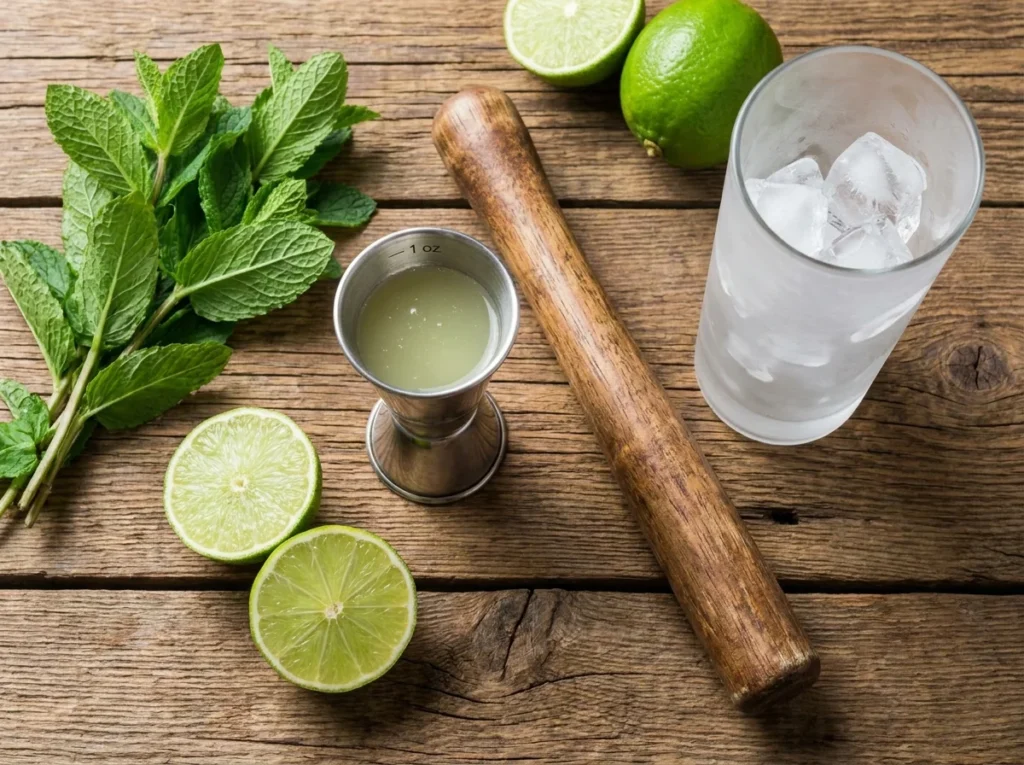
Place 8–10 fresh spearmint leaves in a mixing glass (not the serving glass—use a separate glass for muddling). Do not add sugar yet. The absence of sugar prevents osmotic cellular rupture that would release tannins prematurely.
Squeeze 1 ounce (30ml) of fresh lime juice directly over the mint leaves. The acidic environment immediately begins extracting essential oils while suppressing tannin release.
Using a wooden muddler, apply steady, moderate pressure for exactly 10–15 seconds. Set a timer if necessary. Rotate the muddler slightly as you press—this helps rupture the trichomes at different angles.
The mint leaves should appear visibly bruised and darkened, but you should still see individual leaf structures. If the mixture looks like a green paste, you have over-muddled. Stop immediately.
The aroma at this stage should be intensely minty and fruity—not green or vegetal. If it smells green and grassy, the leaves were likely oxidized before muddling.
Step 3: Add Simple Syrup and Combine
Pour 0.5 ounces (15ml) of pre-made simple syrup into the muddled mint mixture. Stir gently for approximately 5 seconds to combine all ingredients.
The resulting mixture should be a pale green, fragrant liquid with bruised mint particles suspended throughout. Taste a small sample (optional) to verify balance—it should taste minty, slightly sweet, and tart from the lime.
If using granulated sugar instead of simple syrup, dissolve it first in 1 teaspoon of hot water, then add to the mixture and stir for approximately 20 seconds to ensure complete dissolution. Granulated sugar that remains undissolved will create grittiness in the finished drink.
Step 4: Transfer to Serving Glass and Add Ice
Pour the entire muddled mint-lime-syrup mixture into your pre-chilled highball glass. Do not strain out the mint particles—they contribute to mouthfeel and visual appeal.
Fill the glass with 4–6 large clear ice cubes (1.5–2 inches each). Large cubes are essential. They melt slowly, maintaining optimal temperature for 25+ minutes, and have fewer nucleation sites where carbonation bubbles can escape.
At this point, you have the complete mojito base, cold and fragrant. The drink should be visibly pale green with suspended mint particles.
Step 5: Add Carbonated Water (The Critical Final Step)
Pour 3–4 ounces (90–120ml) of cold carbonated water slowly into the glass. Pour slowly to minimize degassing—the escape of CO₂ bubbles.
Stir very gently with a bar spoon for approximately 2–3 rotations clockwise. This barely blends the ingredients. Do NOT stir vigorously—aggressive mixing creates turbulence that accelerates CO₂ escape.
Step 6: Serve Immediately
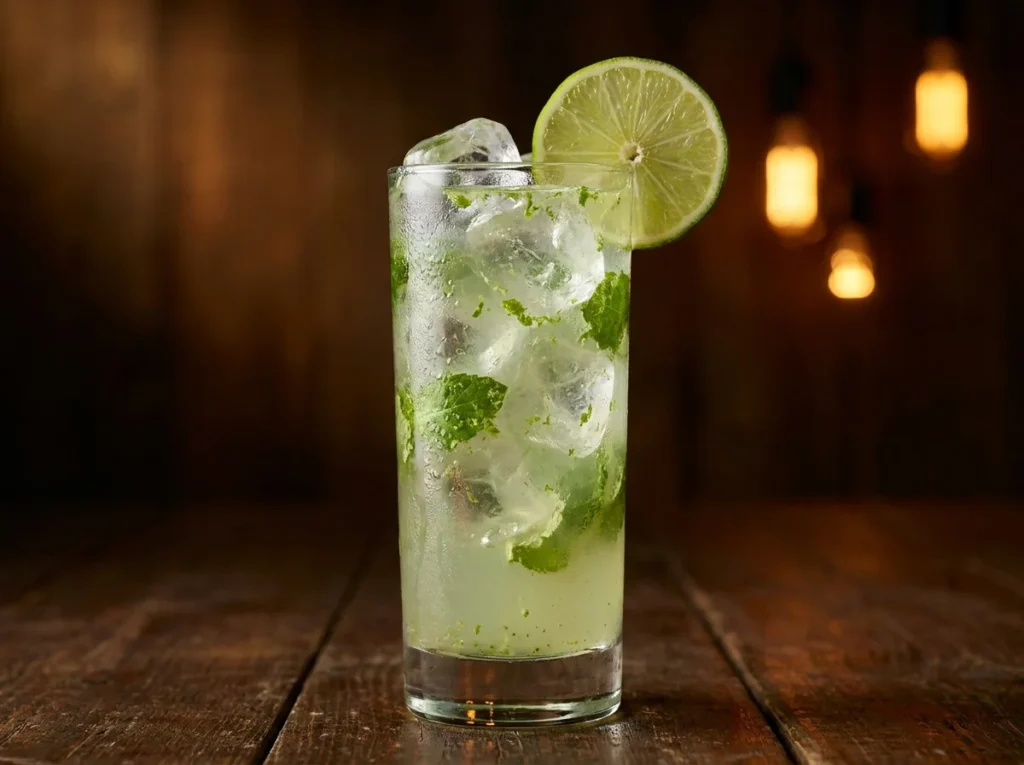
Garnish with a fresh lime wheel placed on the rim or dropped into the drink. Optionally, rim the glass with fine sea salt for a traditional Latin mojito variation.
Serve immediately—within 30 seconds of adding carbonated water. The drink should be consumed within 10–15 minutes for maximum carbonation retention. After this window, ice begins melting rapidly, diluting the flavor and reducing the minty impact.
Nutrition Information (Per Serving)
| Nutrient | Amount | Notes |
|---|---|---|
| Calories | 52 | From simple syrup only; lime and mint negligible |
| Protein | 0.2g | Minimal |
| Total Fat | 0.1g | Negligible |
| Saturated Fat | 0g | None |
| Carbohydrates | 13g | From simple syrup (0.5 oz) |
| Sugars | 12g | Sucrose from simple syrup |
| Sodium | 12mg | From lime juice trace minerals |
| Fiber | 0.3g | From mint leaves |
| Potassium | 85mg | From lime juice and mint |
| Vitamin C | 8–12mg | From fresh lime juice |
| Citric Acid | 0.3g | From lime juice |
Nutritional values based on 0.5 oz simple syrup and fresh lime juice. Carbonated water adds <1 calorie. Mint leaves contribute negligible calories. Values exclude ice.
Chef Albert’s Insight
There is a moment in bartending when technique becomes transparent—when you stop thinking about the steps and start thinking about the principles. You stop asking “What do I do?” and start asking “Why does this work?” The bartender who simply follows a recipe will make a decent drink. The bartender who understands the science—who grasps the essential oil chemistry, the thermal dynamics of ice, the gas solubility equations—will make something that transcends “just a drink.”
I have made this mojito more than eighty times, and every batch teaches me something new about how mechanical action, molecular structure, and human perception intersect. The Flawless Virgin Mojito Secrets are not secrets at all. They are principles made visible through careful observation and relentless precision.
The difference between an amateur bartender and a professional is not skill—it is understanding. Once you understand why each step matters, skill becomes inevitable.
— Chef Albert, Lead Food Scientist at Taste Pillar
Frequently Asked Questions
Can I prepare mojitos in bulk for parties?
No. The Flawless Virgin Mojito Secrets depend on timing that cannot be scaled. Carbonated mojitos must be served within 2–3 minutes of adding sparkling water, or they become flat. The mint volatiles also dissipate over time when exposed to warm air. For parties, prepare the mint-lime-syrup base in advance, then assemble individual drinks just before serving (approximately 1 minute per drink). This approach produces vastly superior results compared to pre-made “mojito pitchers.”
What if my local supermarket does not carry spearmint?
Grow your own. Spearmint is hardy, thrives in containers, and produces leaves continuously throughout the growing season. A single plant ($8–15 from any garden center) provides sufficient mint for dozens of mojitos. Alternatively, use peppermint but reduce the quantity to 6–7 leaves to avoid the medicinal, overpowering character. Moroccan mint (if available at specialty grocers) is superior to both—it has citrus notes that complement the lime juice beautifully.
Why does my mojito taste bitter even though I followed the recipe?
The most likely cause is over-muddling. If you muddled for more than 15 seconds or if the leaves became a paste, you extracted excessive tannins. Tannins are naturally bitter compounds in all plants. Solution: use fresh spearmint and muddle for exactly 10–15 seconds. If bitterness persists, your mint was likely oxidized before muddling (wilted or browning leaves). Always start with fresh, vibrant green spearmint.
Should I use a different type of lime juice if I cannot get fresh limes?
Never use bottled lime juice. The volatile compounds that create freshness have already oxidized during storage and pasteurization. If fresh limes are truly unavailable (rare in the USA), consider making lime cordial at home: combine fresh lime juice with simple syrup (1:1 ratio) and refrigerate for up to 2 weeks. This is not ideal but vastly superior to bottled juice. Better yet, order fresh limes online for delivery.
How long does a mojito stay good in the refrigerator?
A completed mojito should not be refrigerated. Carbonation and optimal temperature are critical to quality. If you must store a mojito, keep it for maximum 2 hours at room temperature (if unavoidable). The drink will lose carbonation and warm up, degrading quality significantly. A properly prepared mojito should be consumed within 10–15 minutes of preparation. Do not attempt to save mojitos—they do not improve with time.
Can I use diet sodas or sugar-free syrups instead of regular simple syrup?
Diet sodas (Coke Zero, Sprite Zero) do not work—artificial sweeteners have different flavor profiles that do not complement mint and lime. Sugar-free simple syrups (using erythritol or stevia) can work, but they lack the viscosity of real sugar, reducing the texture and mouthfeel benefits. If you prefer lower sugar, use allulose (a rare sugar with similar properties to sucrose)—use the same quantity as regular simple syrup. For maximum flavor, stick with traditional granulated sugar.
Related Articles You’ll Love on Taste Pillar
🧀 The Ultimate New York Style Cheesecake: 3 Scientific Secrets to a Flawless, Crack-Free Surface
☕Air Fryer Frozen Salmon: How to Cook Perfectly Flaky Fillets in 12 Minutes
🌮Sheet Pan Steak Fajitas: A Gourmet Mexican Dinner with Zero Cleanup
Chef Albert’s Scientific Virgin Mojito
Ingredients
Equipment
Method
- Place 8-10 fresh spearmint leaves in a mixing glass
- Pour 1 ounce of fresh lime juice over the leaves
- Using a wooden muddler, apply gentle pressure for 10-15 seconds until leaves are bruised (not pulverized)
- Add 0.5-0.75 oz simple syrup (or dissolve granulated sugar in 1 tsp hot water)
- Stir gently to combine
- Transfer mixture to a pre-chilled serving glass
- Add 4-6 large ice cubes
- Pour 3-4 ounces of cold carbonated water
- Stir gently 3-4 times
- Serve immediately with lime wheel garnish
Notes
- Mint must be spearmint (Mentha spicata) for optimal flavor; peppermint is too strong
- Always use fresh lime juice; bottled juice lacks volatile compounds
- Large ice cubes melt slowly and preserve optimal temperature
- Carbonated water must be added just before serving to prevent degassing
- Do not muddle aggressively; gentle bruising preserves menthol while minimizing tannin extraction

5 Comments on “5 Scientific Flawless Virgin Mojito Secrets: The Ultimate Mint Infusion Guide”