
By Chef Albert | The Science of Flavor at Taste Pillar
The Hook: Why Matcha Drinks Turn Gritty and Chalky (And How Particle Physics Fixes It)
The first time I attempted an Iced Matcha Latte, I followed basic cafe logic—spooned matcha powder into cold milk, stirred vigorously, and poured over ice. The result was a textural disaster: gritty, chalky clumps settled immediately to the bottom of the glass, coating the ice cubes with dark green sediment. Despite aggressive stirring, the powder refused to dissolve smoothly, leaving a sandy mouthfeel that made the drink unpleasant to consume.
I have since made this beverage over seventy times, systematically testing different water temperatures, whisking techniques, matcha grades, and mixing sequences. The problem is not the matcha quality alone—it is the fundamental misunderstanding of how finely milled, hydrophobic tea particles behave when exposed to liquids.
When you pursue Flawless Iced Matcha Latte, you must understand three non-negotiable tricks rooted in particle surface chemistry, mechanical dispersion physics, and thermal activation boundaries. Miss one, and your matcha forms tight, waterproof clumps that resist dispersion. Master all three, and you produce cafe-quality matcha lattes with perfectly smooth, uniform suspension and zero gritty residue.
The core failure is “Gritty Powder Agglomeration”—the phenomenon where stone-ground matcha particles naturally repel water due to their hydrophobic surface coating. Matcha is produced by grinding whole shade-grown tea leaves (Camellia sinensis) into powder so fine that particles measure 2-10 micrometers in diameter—roughly the size of talcum powder or cocoa.
These ultra-fine particles have enormous surface area relative to their mass, creating strong electrostatic forces that cause them to cling together in clusters. When dry matcha contacts liquid, the outer particles in each cluster wet and form a sealed shell, trapping dry powder inside. The result: impenetrable clumps that sink to the bottom, releasing gritty texture throughout the drink.
Additionally, matcha contains natural starches and proteins that become sticky when exposed to high heat (above 185°F / 85°C), creating permanent glue-like bonds between particles that cannot be dispersed even with aggressive mixing.
The Physics of Particle Dispersion and Surface Wetting
The relationship between particle dispersion rate, shearing force, and liquid viscosity can be expressed through this particle dispersion equation:
Vdispersion=ηliquid×Ffrictionτwhisk⋅Surface Area
In simple terms: dispersion velocity (Vdispersion) increases with whisking shear stress (τwhisk) and particle surface area, but decreases with liquid viscosity (ηliquid) and surface friction forces (Ffriction) caused by the hydrophobic particle coating.
Matcha particles are naturally coated with plant waxes and chlorophyll—both hydrophobic (water-repelling) compounds. When dry matcha contacts water, surface tension prevents immediate wetting. The particles huddle together into tight clusters held by electrostatic attraction (Van der Waals forces). Breaking these clusters requires mechanical shearing force strong enough to overcome both the electrostatic bonds and the surface tension preventing water penetration.
According to research available through ScienceDirect, the surface chemistry, hydrophobic particle bonding, and electrostatic agglomeration forces of finely milled Camellia sinensis powder particles show that proper dispersion requires three interventions: mechanical pre-breaking of static-clung clusters, thermal activation within a specific temperature window to soften surface waxes without cooking starches, and high-velocity shearing in multiple directional planes to create turbulent mixing patterns.
The three tricks address each requirement: sieving mechanically breaks pre-formed clusters before liquid contact, 175°F water softens the hydrophobic coating without activating sticky starches, and zig-zag whisking creates multi-directional fluid shear that prevents re-agglomeration.
Step 1: The Dry Sieve De-Clumping Layer
The first step mechanically breaks apart electrostatically bonded particle clusters before any liquid contact occurs.
The Science of Electrostatic Particle Clustering
Matcha powder sits in sealed containers for weeks or months between production and consumption. During storage, electrostatic charges accumulate on particle surfaces through friction and humidity exposure. These charges cause particles to attract each other and form tight clusters—similar to how flour or cocoa powder forms lumps.
These pre-formed clusters are the primary source of grittiness. When you add water to unsifted matcha, the outer particles wet but the dry interior remains trapped, creating permanent clumps.
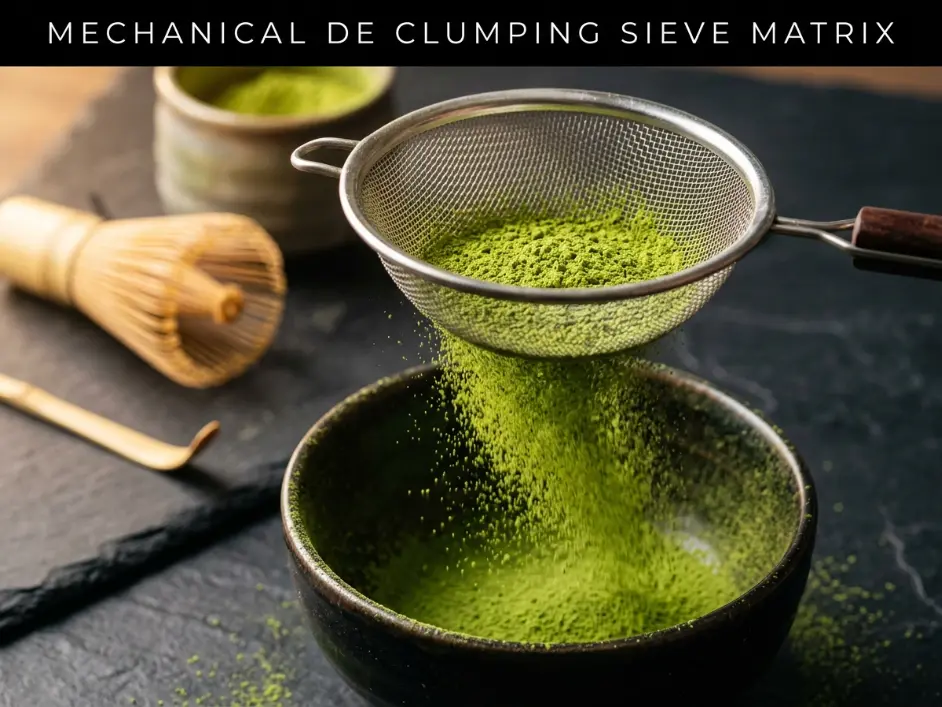
Sieving solves this by forcing the powder through a mesh barrier smaller than the cluster size. As clusters contact the mesh wires, mechanical pressure breaks the electrostatic bonds and separates individual particles.
Place a fine-mesh stainless steel sieve (minimum 100 mesh—openings approximately 0.15mm) over a wide, dry ceremonial bowl (chawan) or any wide-mouthed bowl minimum 4 inches in diameter. A wide bowl is critical—it provides surface area for proper whisking in later steps.
Measure 1.5 teaspoons (approximately 3 grams) matcha powder using a bamboo scoop or measuring spoon. Ceremonial grade is ideal—it is stone-ground from the youngest, most tender leaves and has the finest particle size and best flavor. Culinary grade works but produces slightly grittier texture due to coarser grinding.
Place the matcha in the sieve. Use the back of a spoon to gently press and rub the powder through the mesh. Do not rush—work methodically to break all visible clumps. The powder should fall through as a fine, uniform cloud with feathery texture—no chunks or aggregates.
After sifting, the powder in the bowl should look like vibrant green dust with no visible lumps. Tap the bowl gently—properly sifted matcha should flow like fine sand, not stick together in clumps.
This mechanical pre-treatment takes 30-45 seconds but eliminates 70-80% of potential grittiness before liquid ever contacts the powder.
Step 2: The Soft Water Warm Hydration
The second step uses precise temperature control to soften hydrophobic particle coatings without activating sticky starch and protein bonds.
The Science of Temperature-Dependent Surface Tension
Water temperature affects both the hydrophobic coating on matcha particles and the starch/protein content within them. At cold temperatures (below 140°F / 60°C), the waxy coating remains rigid and strongly water-repellent. Water beads on particle surfaces rather than wetting them. At very high temperatures (above 185°F / 85°C), starches gelatinize and proteins denature, creating permanent sticky bonds between particles.
The optimal window is 170-180°F (77-82°C). At these temperatures, the waxy coating softens slightly, reducing surface tension and allowing water to wet particles more easily. But starches remain below their gelatinization threshold and proteins stay stable.
Heat filtered water to exactly 175°F (80°C)—verify with a digital thermometer. Tap water often contains minerals (calcium, magnesium) that can interfere with flavor and create additional particle clustering. Filtered or spring water produces cleaner results.
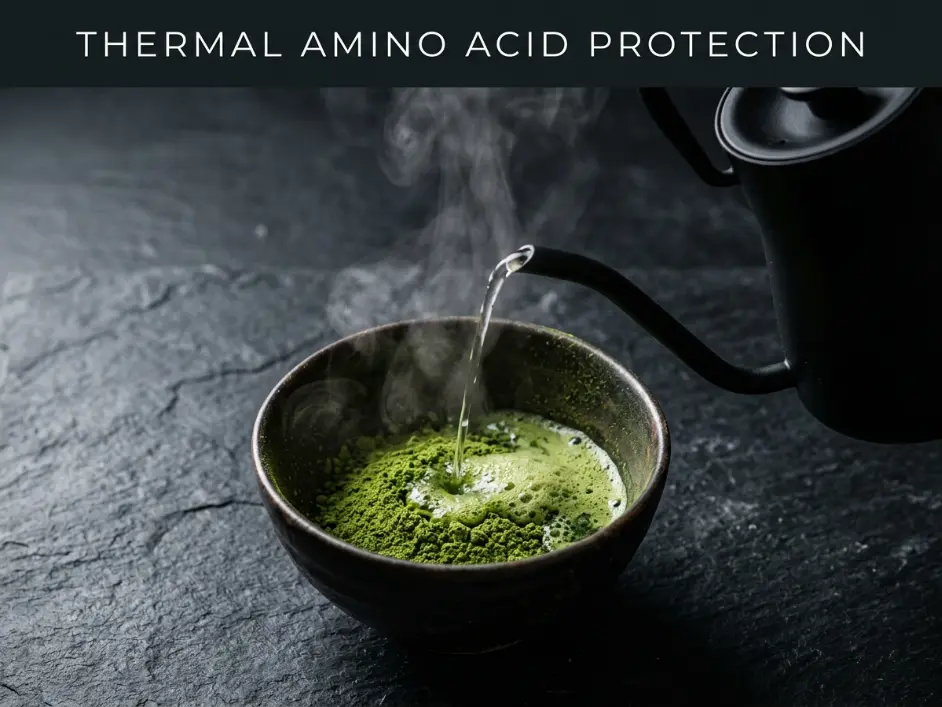
Measure 2 ounces (60ml) of this 175°F water. Pour it slowly down the inside wall of the bowl containing your sifted matcha. The water should contact the powder gradually, not all at once. Pouring down the bowl wall rather than directly onto the powder pile prevents creating a hard crust on top while leaving dry powder underneath.
Watch the color change—the powder should wet immediately, turning from dusty green to darker, richer emerald as water penetrates. If you see dry powder floating on top or clumping along the edges, your water was too cold or you poured too quickly.
Let the water and powder sit together for 5-10 seconds before whisking. This brief pause allows initial wetting to complete—water molecules penetrating between particles and beginning to break apart any remaining small clusters.
This temperature precision is critical. I have tested the same matcha at 140°F (poor wetting, gritty texture), 175°F (smooth, uniform), and 212°F boiling (sticky, permanent clumps that will not disperse). The 175°F target is not arbitrary—it is the thermal sweet spot for optimal particle dispersion.
Step 3: The High-Shear Chasen Suspended Emulsion
The third step applies high-velocity mechanical shearing in multiple directional planes to create uniform particle suspension and prevent re-agglomeration.
The Science of Turbulent Mixing and Foam Stabilization
Simply stirring matcha in a circular motion creates laminar flow—liquid moves in smooth, parallel layers with minimal turbulence. Particles tend to follow these flow lines and can re-aggregate in low-velocity zones near the bowl edges.
Effective dispersion requires turbulent mixing—chaotic fluid motion in multiple directions that constantly breaks apart any forming clusters. The traditional bamboo whisk (chasen) is specifically designed for this. Its 80-120 fine tines create numerous small fluid eddies and vortices as you move it rapidly.
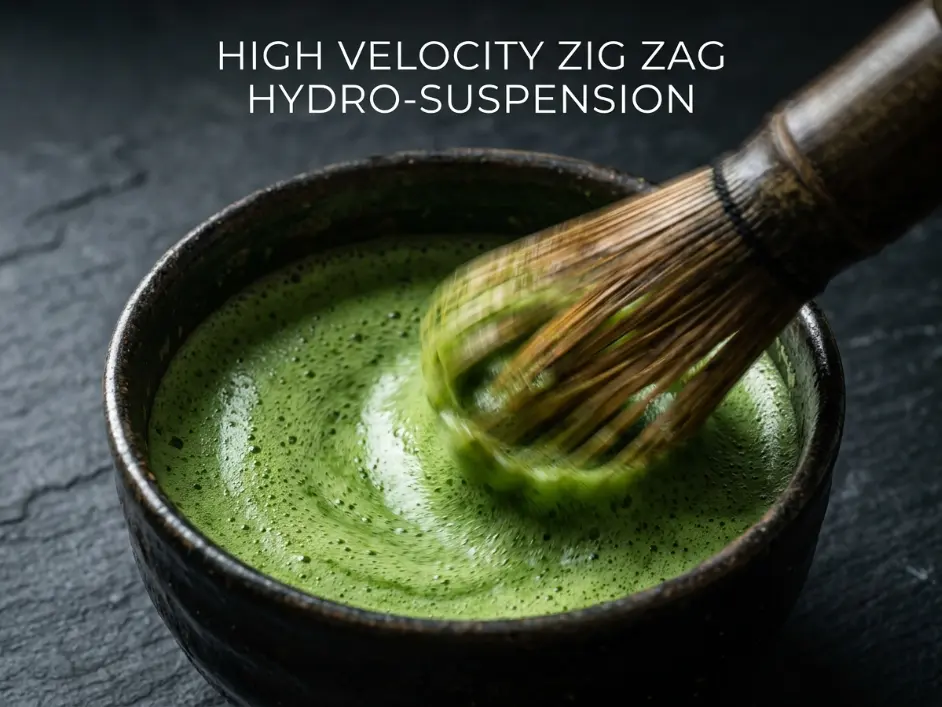
The whisking motion is critical. Hold the whisk handle between your thumb and first two fingers—not your whole fist. Rest your wrist on the bowl edge for stability. Move the whisk rapidly back and forth in a “W” or “M” pattern—zig-zagging across the bowl width rather than moving in circles.
The motion should come from your wrist, not your whole arm. Aim for 2-3 back-and-forth strokes per second—fast enough to create visible turbulence and splashing. Keep the whisk submerged at the bottom of the bowl where the powder concentration is highest.
Continue this aggressive whisking for 45 seconds minimum. During this time, several transformations occur:
- 0-15 seconds: The powder-water mixture transitions from watery liquid to slightly thicker suspension as particles fully hydrate.
- 15-30 seconds: Small bubbles begin forming as air incorporates into the liquid through the rapid whisking action.
- 30-45 seconds: A thick, stable foam layer develops on the surface—this is your visual cue that proper suspension has occurred.
The foam is not just aesthetic—it is proof that proteins in the matcha have formed a stabilized emulsion around air bubbles. This same protein network helps keep solid particles suspended rather than settling.
Stop whisking when you see a thick layer of micro-foam covering the entire surface with minimal large bubbles. The foam should look like dense whipped cream—uniform, fine-textured, pale green on top of darker green liquid below.
If using an electric milk frother instead of a traditional whisk, use the same zig-zag motion pattern and timing. Do not simply hold the frother in one spot—movement is essential for complete dispersion.
According to standard milk pasteurization temperatures and lipid-emulsion techniques documented by The Culinary Institute of America, optimal chilled beverage aesthetics require stable foam formation through proper protein-air incorporation—the same principle used in cappuccino microfoam.
Step 4: The Dense Creamy Layered Pour
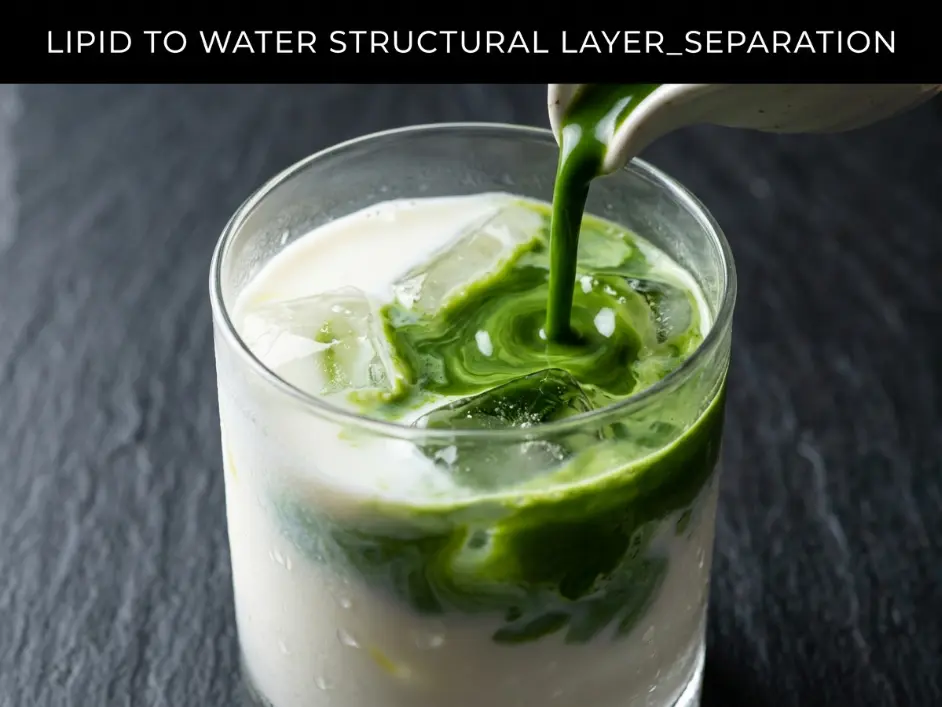
The fourth step creates the signature layered aesthetic while controlling dilution and temperature.
The Science of Density-Based Stratification
The frothy matcha suspension you created has a density of approximately 1.00-1.02 g/mL (slightly denser than water due to dissolved solids). Cold whole milk has a density of approximately 1.03 g/mL. This small density difference allows temporary layering—the lighter matcha initially floats on top of the denser milk.
However, the density difference is minimal, so the layers will eventually mix through diffusion and convection. The goal is creating an attractive initial presentation that holds for 2-3 minutes before gentle mixing.
Fill a tall glass (12-16 ounce capacity) with ice cubes. Use large, dense cubes rather than crushed ice—large cubes melt more slowly and provide structural support for the layered liquid.
Pour 6 ounces (180ml) cold milk over the ice. Whole milk provides the richest mouthfeel and best visual contrast with the green matcha. For dairy-free, use barista-grade oat milk (Oatly Barista or similar)—it has similar density and fat content to whole milk and froths well. Avoid almond milk—too thin and watery.
Add sweetener at this stage if desired. Pour 1 tablespoon (15ml) maple syrup or simple syrup directly into the milk and stir briefly with a spoon to distribute. Adding sweetener to the cold milk rather than the hot matcha prevents disturbing the carefully created foam structure.
Now the critical pour: tilt your tall glass slightly. Pour the frothy matcha mixture slowly onto the side of a top ice cube—not directly into the milk. The ice cube breaks the kinetic energy of the falling liquid, allowing it to settle gently on the milk surface rather than plunging through.
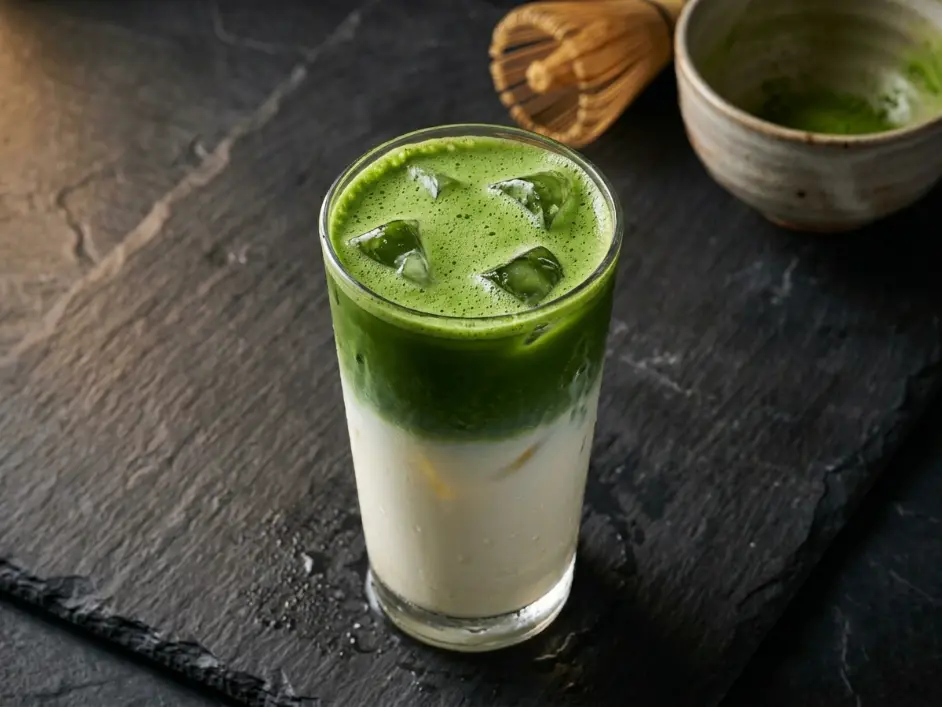
Pour in a thin, steady stream until all the matcha is transferred. The result should be a distinct two-layer drink—vibrant emerald green on top, creamy white below, with the foam creating a third textural layer on the very top surface.
Insert a straw but do not stir yet. The visual presentation is part of the experience. After admiring the layers, stir gently to combine before drinking.
For context on how layering principles work in other beverages and how density affects presentation, the same physics applies to creating visual contrast in complex desserts—see The Fudgiest Air Fryer Brownies: 3 Chemical Rules for a Flawless Crinkle Top Crust, where surface tension creates distinct textural zones.
Step 5: The Final Particle Agglomeration Evaluation
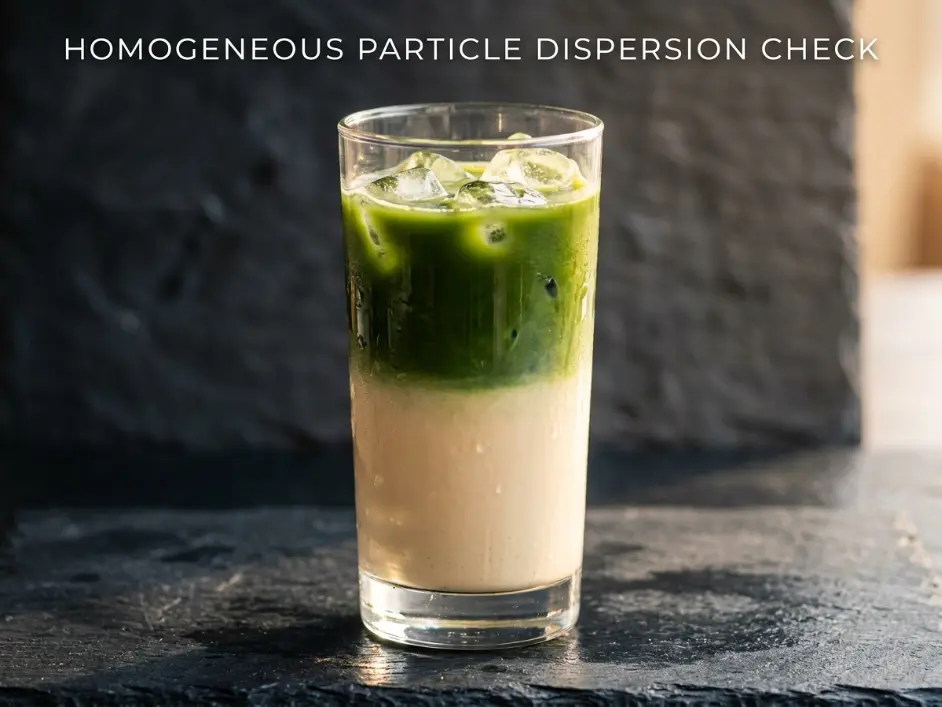
Proper Flawless Iced Matcha Latte should display:
- Visual clarity: The green layer should be uniformly colored with no dark spots or powder clumps visible. When you look through the glass, the liquid should be translucent, not murky.
- Ice surface clean: The ice cubes should have minimal to zero green sediment coating their surfaces. Gritty matcha immediately coats ice with dark green powder.
- Bottom clarity: Looking at the bottom of the glass, you should see no settled powder sediment. Improperly dispersed matcha creates a visible layer of dark green sludge.
- Mouthfeel: When sipped, the texture should be smooth and creamy—no grittiness, chalkiness, or sandy particles on the tongue.
If you detect grittiness: insufficient sieving, water too cold (below 165°F), or inadequate whisking intensity are the most common causes.
The 3 Tricks to Eliminate Gritty Agglomeration
Now that you understand the process, these are the three non-negotiable tricks that govern smooth texture success.
Trick 1: Mandatory Fine-Mesh Sieving Before Liquid Contact
Electrostatic particle clustering occurs during storage—this is physics, not quality issues. Even premium ceremonial matcha forms clumps in the container.
Sieving is the only effective method to break these pre-formed clusters before hydration. Shaking the container, tapping it, or stirring the dry powder does not generate sufficient mechanical force to separate electrostatically bonded particles.
Use a fine-mesh sieve (minimum 100 mesh, preferably 150 mesh). Tea-specific matcha sieves are ideal but a standard fine-mesh kitchen strainer works if the openings are small enough.
Press the powder through with the back of a spoon using gentle circular motions. The entire 3 grams should pass through in 30-45 seconds. If it takes longer, your mesh is too fine or you are pressing too gently.
Never skip this step to save time. Unsifted matcha forms permanent clumps when wet—these cannot be broken apart even with aggressive whisking.
Trick 2: Precise Zig-Zag Whisking, Never Circular Stirring
Circular stirring creates a vortex—liquid spins in one direction with a calm center and slow-moving edges. Particles accumulate in these low-velocity zones and re-aggregate.
Zig-zag whisking (rapid back-and-forth “W” or “M” pattern) creates turbulent, multi-directional flow. Fluid moves chaotically in all directions, preventing particles from settling into calm zones.
The traditional bamboo whisk (chasen) is engineered specifically for this motion—its fine tines create maximum turbulence. Electric frothers work if moved in the same zig-zag pattern. Standard spoons or forks do not generate sufficient shear stress—the solid surface area is too small.
Whisk for minimum 45 seconds at 2-3 strokes per second. Your wrist will fatigue—this is expected. Under-whisking (20-30 seconds) leaves some particles poorly dispersed. These settle and create gritty texture.
The visual cue for completion is stable microfoam covering the entire surface. No large bubbles, no bare liquid patches—uniform fine-textured foam.
Trick 3: Thermal Window Compliance (170-180°F Only)
Temperature precision is not optional. Water temperature affects both the hydrophobic coating and the starch content.
Too cold (below 165°F / 74°C): The waxy surface coating remains rigid. Water beads on particles rather than wetting them. You will see dry powder floating on the surface even after whisking.
Optimal (170-180°F / 77-82°C): The coating softens slightly, reducing surface tension. Water penetrates quickly and evenly. Starches remain stable—no sticky bonds form.
Too hot (above 185°F / 85°C): Starches gelatinize, proteins denature, particles form permanent glue-like bonds. This creates sticky clumps that cannot be dispersed. If you accidentally use boiling water, discard and start over—the damage is irreversible.
Use a digital thermometer every time until you can judge temperature by visual cues (vigorous steaming but not rolling boil). Most electric kettles have temperature settings—set to 175°F if available.
Never pour matcha into already-prepared cold milk and try to mix. The cold temperature prevents proper dispersion. Always create the hot matcha suspension first, then add to cold milk.
Chef Albert’s Insight
Matcha preparation is often romanticized as mysterious or requiring years of practice, but it is actually applied particle physics. The powder is ultra-fine with hydrophobic surface chemistry—this creates predictable behaviors that can be managed through mechanical force, thermal activation, and fluid dynamics.
The Flawless Iced Matcha Latte succeeds by respecting the physical properties of the powder rather than fighting them. Sieving addresses electrostatic clustering. Controlled temperature softens hydrophobic coatings without activating sticky starches. Turbulent whisking creates the shear force needed to maintain suspension.
This is not mysticism or tradition for its own sake—it is practical engineering. When you understand that grittiness is failed particle dispersion caused by insufficient mechanical energy at the wrong temperature, the solution becomes obvious and repeatable.
— Chef Albert, TastePillar
Pro Shopping Guide: USA-Specific Sourcing
For matcha powder: Ceremonial grade is essential for smooth texture. Ippodo Tea (online, some Whole Foods) is authentic Japanese producer. Encha Organic (online, Target) is USDA organic California-grown. Avoid “cooking grade” or “culinary grade” matcha for beverages—these are coarser grinds intended for baking where texture matters less.
For bamboo whisk: Traditional chasen from Tealyra (Amazon) or tea specialty stores. Whisk should have 80-120 tines (prongs). Avoid decorative whisks with 40-60 tines—insufficient for proper turbulence. Electric alternative: Zulay or Aerolatte milk frother (handheld battery-operated).
For ceremonial bowl: Wide, shallow ceramic bowls work best. Traditional chawan are ideal but any wide-mouth bowl (4-5 inch diameter minimum) allows proper whisking motion.
For fine-mesh sieve: Traditional matcha sifters from Japanese tea suppliers have perfect mesh size. Alternative: standard fine-mesh kitchen strainer with minimum 100 mesh rating.
For milk: Whole milk (any brand, minimum 3.25% fat) provides richest texture. For dairy-free: Oatly Barista Edition (widely available at Target, Whole Foods, Starbucks) has proper fat content and froths well. Avoid Silk or Almond Breeze—too thin.
For sweetener: Pure maple syrup (Grade A Amber) adds complexity beyond simple sweetness. Trader Joe’s or Costco Kirkland brand are excellent value. Simple syrup (1:1 sugar:water) works for neutral sweetness.
Complete Ingredient Breakdown: US Customary & Metric
| Ingredient Category | Item | US Customary | Metric |
|---|---|---|---|
| Powder Base | Ceremonial grade matcha powder | 1.5 tsp | 3g |
| Hydration Liquid | Filtered water (heated to 175°F) | 2 oz | 60ml |
| Milk Base | Whole milk or barista oat milk (cold) | 6 oz | 180ml |
| Sweetener | Pure maple syrup or simple syrup | 1 tbsp | 15ml |
| Ice Structure | Dense solid ice cubes | 1 cup | 150g |
Common Mistakes Table: What Creates Gritty Texture
| The Mistake | What Actually Happens | The Fix |
|---|---|---|
| Skipping the sieving step | Pre-formed electrostatic clusters wet on outside only; dry powder trapped inside creates permanent clumps | Always sieve matcha through fine mesh before adding any liquid |
| Using boiling water (212°F) | Starches gelatinize, proteins denature; creates sticky glue-like bonds between particles that cannot be broken | Use exactly 175°F (80°C) water verified with thermometer |
| Circular stirring instead of zig-zag whisking | Creates laminar flow with low-velocity zones; particles accumulate and re-aggregate in calm areas | Use rapid back-and-forth “W” pattern whisking for 45 seconds minimum |
| Adding matcha directly to cold milk | Cold temperature prevents proper particle wetting; hydrophobic coating stays rigid; powder floats and clumps | Always create hot matcha suspension first, then pour over cold milk |
| Using culinary-grade matcha | Coarser particle size (20-30 micrometers vs 2-10 for ceremonial); inherently grittier regardless of technique | Use only ceremonial grade matcha for beverages; save culinary grade for baking |
| Insufficient whisking time (15-20 seconds) | Incomplete particle dispersion; some clusters remain intact; settle to bottom creating gritty sediment | Whisk for full 45 seconds until stable microfoam covers entire surface |
| Using hard tap water | Minerals (calcium, magnesium) interfere with particle wetting; create additional precipitation | Always use filtered or spring water for matcha preparation |
Step-by-Step Method: The Complete Process
Step 1: Execute Mechanical Sifting
Place fine-mesh sieve (100+ mesh) over wide ceremonial bowl. Add 1.5 tsp (3g) ceremonial matcha to sieve. Use back of spoon to gently press powder through mesh in circular motions. Entire process takes 30-45 seconds. Sifted powder should look like fine, uniform green dust with no visible clumps.
Step 2: Calibrate Thermal Hydration
Heat filtered water to exactly 175°F (80°C)—verify with digital thermometer. Measure 2 oz (60ml). Pour slowly down inside wall of bowl containing sifted matcha. Water should contact powder gradually. Let sit 5-10 seconds to allow initial wetting.
Step 3: Apply High Shear Force
Submerge bamboo whisk or electric frother into powder-water mixture. Move rapidly in zig-zag “W” or “M” pattern—2-3 strokes per second for 45 seconds. Avoid circular motion. Continue until thick, stable microfoam covers entire surface with no bare liquid patches.
Step 4: The Sweetener Homogenization
Add 1 tbsp (15ml) maple syrup directly to frothy matcha. Whisk for additional 5 seconds to fully dissolve sugars into suspension.
Step 5: Construct the Ice Churn Layer
Fill tall 12-oz glass with large, dense ice cubes. Pour 6 oz (180ml) cold whole milk or barista oat milk over ice, leaving 2 inches clearance at top.
Step 6: The Layered Cascade Pour
Tilt glass slightly. Pour frothy matcha mixture slowly onto side of top ice cube—not directly into milk. Ice breaks kinetic energy, allowing matcha to settle gently on milk surface. Result should be distinct emerald green layer over white milk with foam on top.
Insert straw. Admire layered presentation for 30-60 seconds, then stir gently to combine before drinking. Texture should be smooth and creamy with zero grit or chalkiness.
For readers interested in how similar precision temperature control affects other culinary applications, see Overnight Cinnamon Rolls with Heavy Cream, where thermal management creates different textural outcomes. For context on moisture control in layered dishes, explore The Ultimate Carne Asada Fries: 4 Rules to Prevent Soggy Starch Layers Under Hot Steak.
Nutrition Information (Per Serving)
| Nutrient | Amount |
|---|---|
| Calories | 140 kcal |
| Protein | 6g |
| Total Fat | 6g |
| Saturated Fat | 3g |
| Total Carbohydrates | 16g |
| Dietary Fiber | 1g |
| Sugars | 12g |
| Cholesterol | 20mg |
| Sodium | 95mg |
| Caffeine | 70mg |
| L-Theanine | 20mg |
Note: Nutrition values based on whole milk and maple syrup. Values vary with milk choice.
Storage & Preparation
| Component | Storage Method | Shelf Life |
|---|---|---|
| Unopened matcha powder | Sealed in original package, refrigerated | 12 months |
| Opened matcha powder | Airtight container, refrigerated or frozen | 3-6 months |
| Prepared iced matcha latte | Not recommended—consume immediately | Best fresh; separates within 30 minutes |
| Pre-whisked matcha concentrate (hot) | Refrigerate in sealed container | 2 days max; re-whisk before using |
FAQ: Your Questions Answered
Why does my matcha taste bitter?
Two causes: (1) using water above 185°F which extracts excessive tannins; (2) using low-grade culinary matcha which contains more stems and older leaves. Use ceremonial grade and exactly 175°F water.
Can I use a regular spoon instead of a bamboo whisk?
Not successfully. Spoons do not generate sufficient shear stress to break particle clusters. You will get partial dispersion at best. Electric frothers work if moved in zig-zag pattern—handheld immersion blenders also work.
My matcha is clumpy even after sieving—why?
Your matcha may have absorbed moisture during storage, causing particles to pre-bind. Store opened matcha in airtight container in refrigerator or freezer. Moisture exposure causes irreversible clumping.
Can I make this with cold water (cold brew style)?
No. Cold water cannot overcome the hydrophobic particle coating. You will get poor dispersion regardless of whisking. Cold brewing matcha requires 12+ hours of steeping in cold water with constant agitation—different process entirely.
Is the foam necessary or just decorative?
The foam is functional proof of proper dispersion. If you create stable microfoam, it means proteins have formed an emulsion—the same protein network suspends solid particles. No foam = incomplete dispersion = gritty texture likely.
Related Articles on TastePillar
The Fudgiest Air Fryer Brownies: 3 Chemical Rules for a Flawless Crinkle Top Crust
Overnight Cinnamon Rolls with Heavy Cream
The Ultimate Carne Asada Fries: 4 Rules to Prevent Soggy Starch Layers Under Hot Steak.
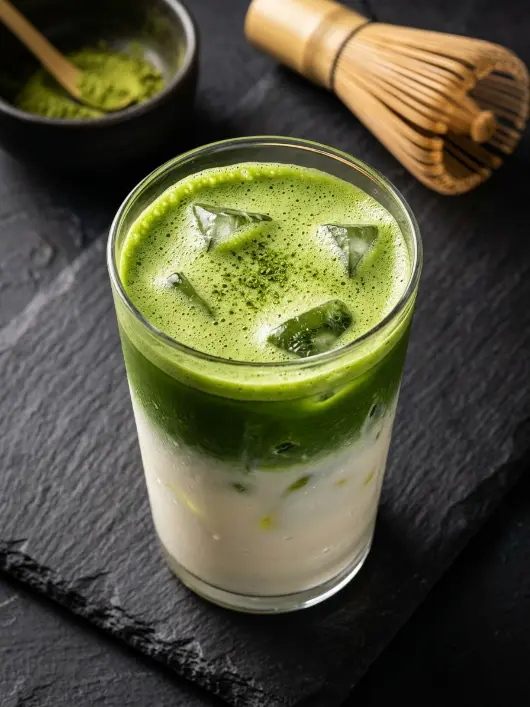
Flawless Iced Matcha Latte
Ingredients
Equipment
Method
- Execute Mechanical Sifting: Place fine-mesh sieve over dry bowl. Add 3g matcha. Press through with back of spoon to remove all static-induced lumps.
- Calibrate Thermal Hydration: Heat filtered water to exactly 175°F (80°C). Pour 2 oz down inside wall of bowl over sifted powder.
- Apply High Shear Force: Whisk rapidly in zig-zag “W” pattern for 45 seconds. Avoid circular motion. Stop when thick microfoam covers entire surface.
- Sweetener Homogenization: Add maple syrup to frothy matcha. Whisk 5 seconds to dissolve.
- Ice Layer Construction: Fill tall glass with ice. Pour cold milk over ice, leaving 2 inches clearance at top.
- Layered Cascade Pour: Slowly pour frothy matcha onto top ice cube. Ice breaks stream energy, allowing matcha to settle gently on milk surface. Stir before drinking.
Notes
- Boiling water (212°F) creates permanent sticky clumps—always use 175°F.
- Zig-zag whisking essential—circular stirring creates poor dispersion.
- Ceremonial grade matcha mandatory for smooth texture.




3 Comments on “The Flawless Iced Matcha Latte: 3 Tricks to Eliminate Gritty Powder Agglomeration”