By Chef Albert | The Science of Flavor at Taste Pillar
The Hook: Why Most No-Bake Cheesecakes Turn Into Pudding (And How Fat Physics Fixes It)
The first time I attempted No-Bake Strawberry Cheesecake, I followed a typical recipe—mixed cream cheese with sugar, folded in whipped cream, poured it over a graham crust, and chilled overnight. The result was a textural disaster: when I released the springform pan, the filling slumped outward like thick pudding. Slicing was impossible—the “cheesecake” flowed across the plate, weeping liquid and refusing to hold its shape.
I have since made no-bake cheesecakes over forty times, systematically testing different cream cheese types, whipping cream fat percentages, fruit moisture levels, and chilling times. The problem is not the concept—it is the fundamental misunderstanding of how dairy fat crystallization creates structure without gelatin.
When you pursue No-Bake Strawberry Cheesecake, you must understand four non-negotiable foundational rules rooted in lipid crystallization physics, protein network formation, and water activity control. Miss one, and your cheesecake emerges either soupy and unstable or dense and rubbery. Master all four, and you produce bakery-quality cheesecake with a smooth, creamy texture that slices cleanly and holds its shape at room temperature for hours.
The core failure is “Chilled Structural Collapse”—the phenomenon where insufficient fat crystallization and excess moisture prevent the filling from setting into a firm, sliceable matrix. Traditional baked cheesecakes rely on egg proteins that coagulate at high temperatures, creating a gel network that traps moisture and fats. No-bake versions must achieve the same structural integrity through fat crystallization alone—solid milk fat globules forming a three-dimensional network that physically entraps liquid.
This works only if you maximize the ratio of solid fats to liquid components and minimize free water that would prevent proper crystallization. Most recipes fail because they use the wrong type of cream cheese (spreadable tubs contain added water and emulsifiers), add too much liquid (fruit purees that haven’t been reduced), or use insufficient fat content in the whipping cream.
The Physics of Fat Crystallization and Emulsion Stability
The relationship between dairy fat crystals, water activity, and structural stability can be expressed through this emulsion equation:
τ=η0⋅γ˙+Water Activity (aw)ϕfat⋅G′
In simple terms: the shear stress (τ) required to deform your cheesecake—its resistance to slumping—is determined by the base viscosity (η0) multiplied by the shear rate, plus a structural term where the volume fraction of crystallized fats (ϕfat) and the elastic modulus (G′) are divided by water activity (aw).
High water activity (free, unbound moisture) weakens the structure. High crystallized fat volume strengthens it. The goal is maximizing ϕfat while minimizing aw.
Milk fat exists in multiple crystalline forms depending on temperature. At refrigerator temperatures (35-40°F / 2-4°C), milk fat crystallizes into a β’ crystal structure—small, needle-like crystals that interlock to form a firm network. At warmer temperatures, these crystals melt, and the structure collapses.
According to research available through ScienceDirect, the lipid-protein interaction and lipid stabilization matrices of high-fat dairy cheese emulsions show that proper crystal network formation requires minimum 30% fat by weight, proper tempering (slow, consistent cooling), and minimal free water that would dilute the fat phase.
The four rules address each of these requirements systematically: selecting high-fat dairy products, reducing fruit moisture through evaporation, building proper protein networks through mechanical whisking, and managing crystallization through controlled chilling.
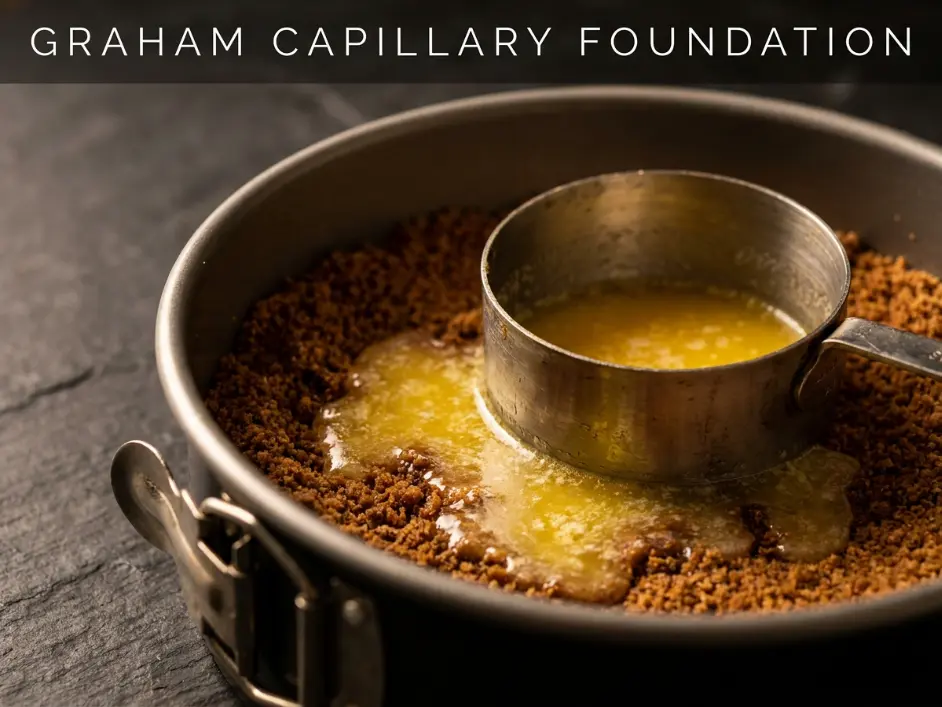
Step 1: The Graham Cracker Capillary Matrix
The first step establishes a hydrophobic (water-repelling) foundation that prevents moisture from the filling from saturating the crust and creating a soggy base.
The Science of Crust Stability
Graham crackers are primarily wheat flour and sugar—both hydrophilic (water-attracting) materials. Without treatment, a graham crust would absorb moisture from the cheesecake filling like a sponge, becoming soft and sticky. Adding melted butter solves this problem through lipid coating.
When you mix finely ground graham crumbs with melted butter, the liquid fat coats each starch particle, creating a hydrophobic barrier. As the butter cools and solidifies, these coated particles pack together into a dense, water-resistant matrix held together by crystallized fat.
Place 1.5 cups (150g) graham crackers (about 10 full crackers) into a food processor. Pulse 15-20 times until the crackers are uniformly ground into fine crumbs—no large chunks, but not powdered either. You want a consistency similar to coarse sand.
Transfer to a mixing bowl. Add 6 tablespoons (85g) melted unsalted butter and 1 tablespoon (12g) granulated sugar. Mix thoroughly with a fork until the mixture resembles wet sand—every crumb should be coated with butter. When you squeeze a handful, it should hold together in a clump.
Press this mixture firmly into the bottom of an 8-inch springform pan. Use the bottom of a flat-bottomed glass or measuring cup to pack it down tightly—the tighter you compress it, the firmer the final crust. You want a compact, even layer approximately ¼ inch thick.
Place the pan in the freezer for 10 minutes. This chilling serves two purposes: it pre-solidifies the butter, creating a firm base before you add the filling, and it chills the pan itself, which helps the filling set faster when poured.
Do not skip this freezing step. A warm crust will partially melt when the filling is added, compromising the barrier between crust and filling.
Step 2: Strawberry Puree Reduction Pectin Sync
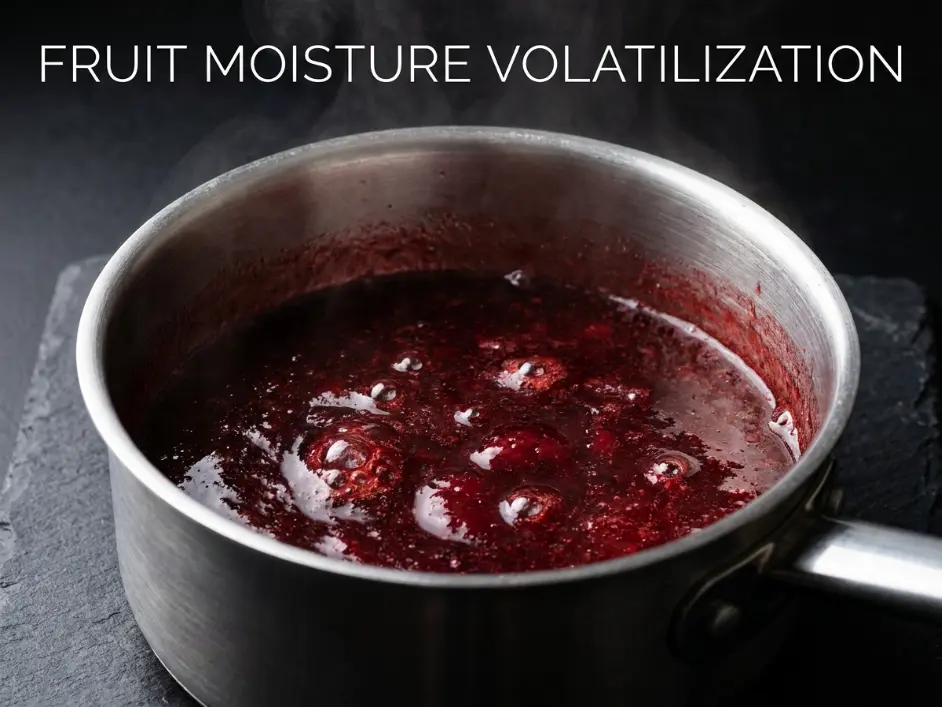
The second step eliminates excess moisture from strawberries while concentrating natural fruit pectins—polysaccharides that contribute to gel formation and structural stability.
The Science of Moisture Reduction
Fresh strawberries are approximately 91% water by weight. If you add pureed strawberries directly to cream cheese, you are introducing massive amounts of free water that dilutes the fat phase and prevents proper crystallization. The filling will never set firm—it remains a thick liquid.
The solution is evaporative reduction. By simmering strawberries until they lose 50% of their volume, you drive off water as steam while concentrating sugars, acids, and most importantly, pectins.
Strawberries contain approximately 0.6-0.9% pectin by weight—lower than high-pectin fruits like apples or citrus, but sufficient for our purposes. Pectin is a structural polysaccharide found in plant cell walls. When heated in the presence of sugar and acid, pectin molecules partially dissolve and form a weak gel network.
Hull and chop 1.5 cups (250g) fresh strawberries. Place in a blender or food processor and puree until completely smooth—no chunks. You should have approximately 1 cup of liquid puree.
Pour the puree into a small saucepan. Add 2 tablespoons (25g) granulated sugar. The sugar serves multiple functions: it lowers water activity by binding water molecules, it provides sweetness, and it assists pectin gel formation.
Place over medium-low heat and bring to a gentle simmer. Cook, stirring frequently to prevent scorching, for 12-15 minutes. Watch the volume carefully. You want to reduce the puree to exactly half its original volume—from 1 cup to ½ cup.
Visual cues: the puree will darken from bright red to deep crimson. It will thicken noticeably—bubbles will become slower and larger, indicating higher viscosity. When you drag a spoon through it, the trail should hold for 2-3 seconds before flowing back together.
Remove from heat and transfer to a clean bowl. Let cool completely to room temperature before using—approximately 30 minutes. Warm puree would melt the cream cheese and prevent proper emulsification.
This reduction technique parallels moisture control methods used in other desserts. For context on managing liquid ratios in different baking applications, see The Fudgiest Air Fryer Brownies: 3 Chemical Rules for a Flawless Crinkle Top Crust, where water content critically affects texture.
Step 3: High-Shear Cream Cheese Lamination
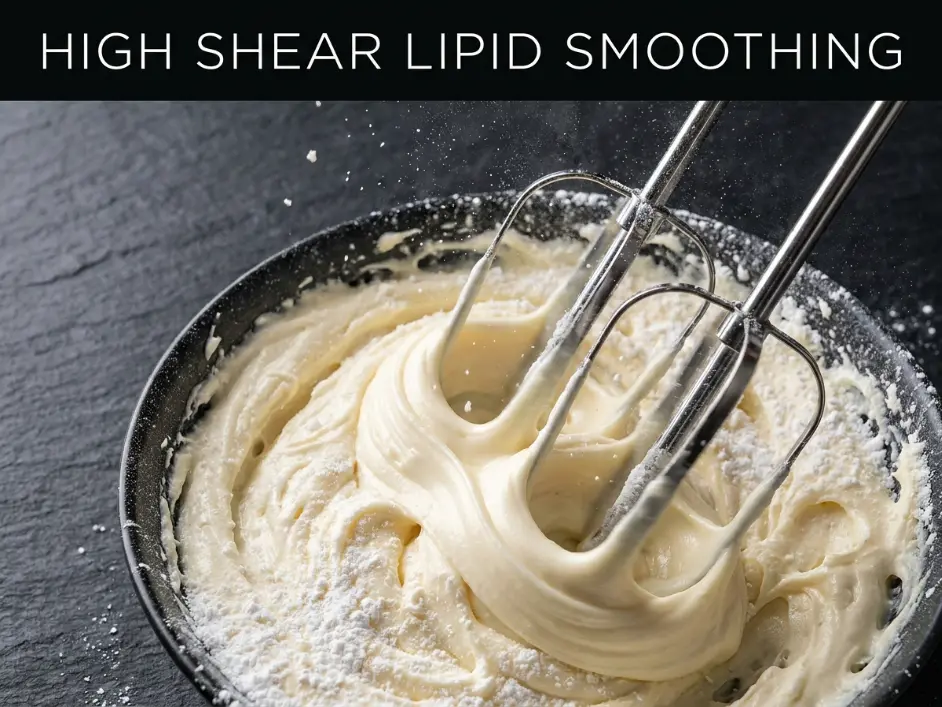
The third step mechanically processes cream cheese to create a smooth, lump-free base with properly dispersed fat globules.
The Science of Protein Network Formation
Cream cheese is an acid-set fresh cheese containing approximately 33% milk fat, 55% water, and 12% protein and other solids. The fat exists as microscopic globules (2-10 micrometers diameter) dispersed throughout a protein-water matrix.
When cold cream cheese comes straight from the refrigerator, these fat globules are rigid and the protein network is tight. Trying to mix cold cream cheese results in lumps—the stiff fat globules cannot blend smoothly. Letting cream cheese come fully to room temperature (70°F) makes it too soft—the fat globules partially melt and the mixture becomes greasy.
The optimal temperature is slightly softened—about 60-65°F. At this temperature, the fat globules are pliable enough to be dispersed by mechanical mixing but still solid enough to contribute to structure.
Remove 16 ounces (450g) of block-style full-fat cream cheese from the refrigerator 15-20 minutes before starting. This is critical: you must use block cream cheese in foil wrapping, not spreadable cream cheese in plastic tubs. Spreadable varieties contain added water, stabilizers, and emulsifiers that increase water activity and prevent proper crystallization.
Cut the slightly softened cream cheese into 1-inch cubes. Place in the bowl of a stand mixer fitted with the paddle attachment (or use a hand mixer with beaters in a large bowl).
Add 1 cup (120g) powdered sugar. Powdered sugar is essential—granulated sugar would remain gritty. Powdered sugar contains 3-5% cornstarch (added to prevent caking), which also helps absorb residual moisture.
Beat on medium-high speed for 3 full minutes. During this time, the mechanical shearing action breaks up any lumps, disperses the fat globules evenly, and incorporates tiny air bubbles that lighten the texture. The mixture should become completely smooth, pale, and fluffy—almost doubled in volume.
Add the cooled strawberry reduction (½ cup) and 1 teaspoon (5ml) pure vanilla extract. Beat on low speed for 30 seconds until just incorporated and uniform pale pink color.
Do not overmix after adding the fruit—excessive mixing would break down the fat globules too much, creating a greasy rather than creamy texture.
According to classical structural setting ratios documented by The Culinary Institute of America, non-gelatin chilled desserts require proper mechanical homogenization of dairy fats to achieve stable emulsions without chemical stabilizers.
Step 4: The Aerated Dairy Foam Fold
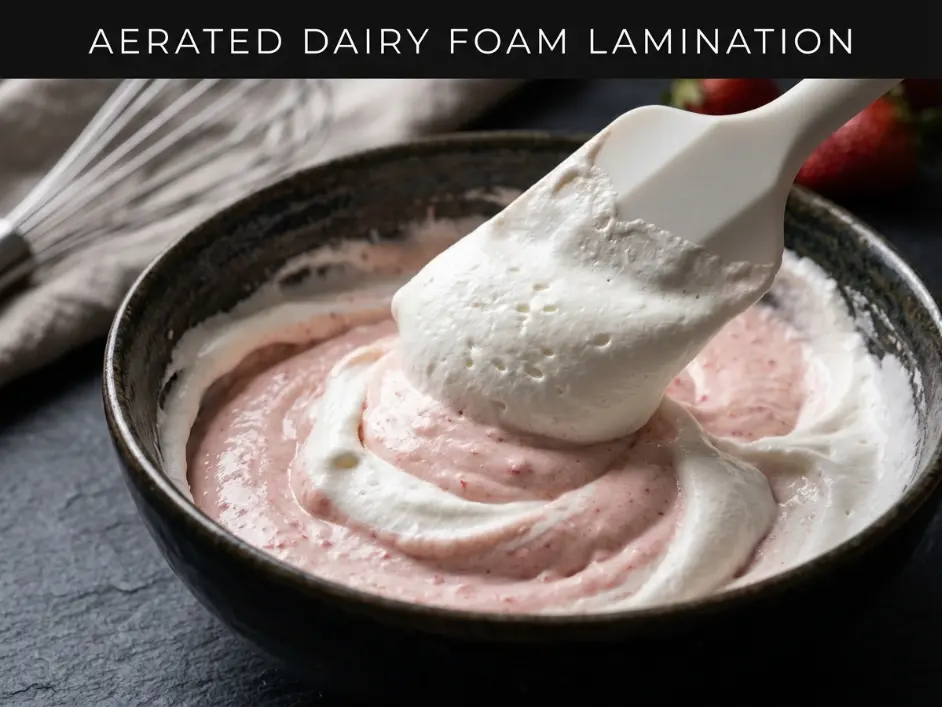
The fourth step incorporates whipped cream—a stabilized foam that provides both structure and smooth mouthfeel.
The Science of Foam Stabilization
Heavy whipping cream contains approximately 36-40% milk fat. When you whip cream, you are performing three simultaneous processes:
First, mechanical whisking incorporates air bubbles into the cream. Second, the physical agitation partially breaks down the membranes surrounding fat globules, allowing them to coalesce slightly. Third, these partially coalesced fat globules migrate to the air-liquid interfaces, forming a protective layer around each air bubble.
This creates a foam—air bubbles stabilized by a network of fat-coated protein films. When properly whipped to stiff peaks, this foam is stable enough to support structure.
Pour 1 cup (240ml) cold heavy whipping cream (minimum 36% fat—check the label) into a chilled mixing bowl. Using a hand mixer or stand mixer with whisk attachment, whip on high speed for 2-3 minutes.
Watch for progressive stages:
- Soft peaks (1-1.5 minutes): Cream thickens and forms gentle peaks that slump over when you lift the whisk.
- Medium peaks (1.5-2 minutes): Peaks hold their shape but tips curl slightly.
- Stiff peaks (2-3 minutes): Peaks stand straight up without drooping. The cream looks glossy and smooth, not grainy.
Stop at stiff peaks. Over-whipping breaks down the foam structure and can eventually turn cream into butter through excessive fat coalescence.
The folding technique is critical for preserving this foam structure. Add one-third of the whipped cream to the strawberry cream cheese mixture. Use a silicone spatula to stir vigorously—this first addition lightens the dense cream cheese, making it easier to fold in the remaining cream without deflating it.
Add the remaining whipped cream. Now switch to gentle folding: scrape the spatula along the bottom of the bowl, lift upward through the center, and fold over the top. Rotate the bowl and repeat. Count your folds—15-20 total should be sufficient.
You should see white streaks gradually disappear as the mixtures combine. A few small streaks are acceptable—they will disappear as the filling sets. Over-folding deflates the air bubbles and creates a dense, heavy texture.
The final mixture should be light, fluffy, pale pink, and hold soft peaks when you lift the spatula.
For context on how protein-fat interactions create different textures in other recipes, see the discussion in Overnight Cinnamon Rolls with Heavy Cream, where dairy richness contributes to completely different structural outcomes.
Step 5: Crystallization Chill and Final Setting
Pour the filling over the chilled graham crust in the springform pan. Use a spatula to spread evenly and smooth the top surface. Tap the pan gently on the counter 2-3 times to release any large air bubbles trapped during folding.
Cover the pan loosely with aluminum foil—do not let the foil touch the filling surface, as it will stick and mar the smooth top. Refrigerate for minimum 6 hours, preferably overnight (8-12 hours).
The Science of Fat Crystallization
During this chilling period, the milk fats in both the cream cheese and whipped cream undergo crystallization. At refrigerator temperature (35-38°F / 2-3°C), the fat transitions from a fluid or semi-fluid state to a solid crystalline state.
This is not freezing—the water remains liquid. But the fats solidify, and because they form an interconnected network throughout the filling, they create a firm, sliceable structure.
The time requirement is based on heat transfer and crystal formation kinetics. The center of the cheesecake must reach refrigerator temperature throughout, and the fat crystals must grow to sufficient size and number to form a strong network. This takes time—rushing it by using the freezer would create ice crystals that damage texture.
After 6 hours minimum, the cheesecake should be firm to the touch when you press gently on the center. To remove from the springform pan, run a thin knife around the edge to loosen any stuck areas, then release the spring clip and lift away the ring.
For clean slices, dip a sharp chef’s knife in hot water, wipe dry, and cut. Wipe the knife clean between each cut and re-warm as needed. The heat slightly melts the fat where the knife contacts, allowing clean cuts without dragging or tearing.
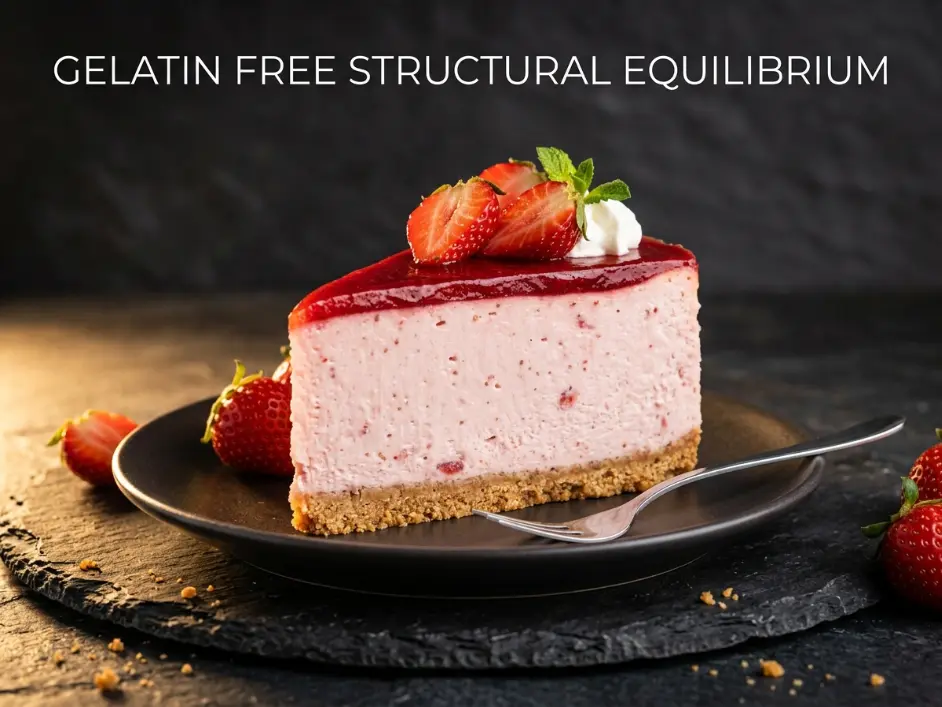
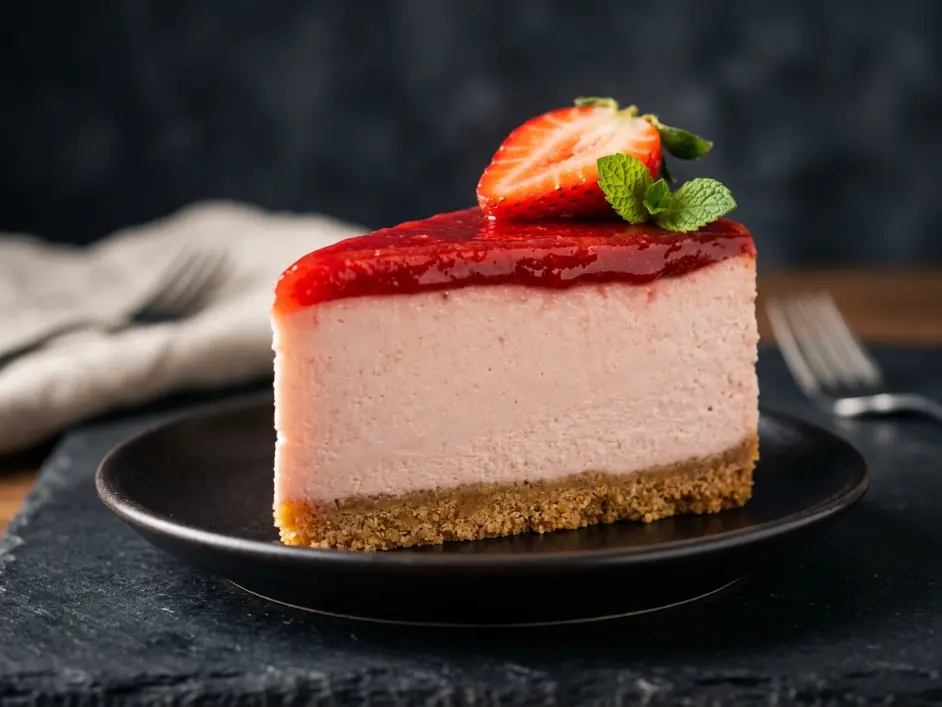
Proper Flawless No-Bake Strawberry Cheesecake should hold its shape at room temperature for 2-3 hours before the fat crystals begin melting. The slice should be smooth, creamy, and stable—not weeping liquid or slumping.
The 4 Foundational Rules for Stable Emulsion
Now that you understand the process, these are the four non-negotiable rules that govern structural success.
Rule 1: Mandatory Block Cream Cheese with Minimum 33% Fat
The type of cream cheese determines structural outcome. Block cream cheese (Philadelphia, store brands in foil wrapping) contains approximately 33% fat and 55% water. Spreadable cream cheese (plastic tubs, whipped varieties) contains added water, vegetable gums, and emulsifiers that increase water activity to 60-65%.
That extra 5-10% water prevents proper fat crystallization. The filling remains soft and pudding-like even after extended chilling.
Always use block cream cheese. Check the ingredient label—it should list only milk, cream, salt, and cultures. Avoid anything with “guar gum,” “xanthan gum,” or “modified food starch.”
Slightly softened (60-65°F) is ideal for mixing. Fully cold (40°F) creates lumps. Room temperature (70°F+) becomes greasy.
Rule 2: Evaporative Fruit Reduction to 50% Original Volume
Fresh fruit purees introduce excessive moisture. The evaporative reduction step is non-negotiable.
Simmer strawberry puree with sugar until volume reduces by half. This concentrates flavor, removes free water, and concentrates natural pectins that contribute to structure.
The cooled reduction should be thick and glossy—similar to thick jam consistency. If it is thin and pourable, continue reducing.
Never skip this step or substitute with jam/preserves (which contain added pectin and sugar in different ratios that will not set properly).
Rule 3: Minimum 36% Fat Heavy Cream Whipped to Stiff Peaks
Whipping cream must contain minimum 36% fat. Lower-fat “light whipping cream” (30% fat) will whip but produces weaker foam that cannot support structure.
Check labels carefully. Many brands are exactly 36%. Premium brands may reach 38-40%, which is even better.
Whip to stiff peaks—peaks that stand straight without drooping. Under-whipped cream (soft or medium peaks) contains too much liquid phase and insufficient foam stability.
Over-whipped cream turns grainy and begins separating into butter—also unusable.
The window between stiff peaks and over-whipped is approximately 30-60 seconds. Watch carefully during the final stage.
Rule 4: Extended Crystallization Chill at 35-38°F for Minimum 6 Hours
Fat crystallization cannot be rushed. The filling must remain at refrigerator temperature (35-38°F / 2-3°C) for minimum 6 hours for proper crystal network formation.
Warmer refrigerators (40°F+) slow crystallization. The cheesecake may not set firm even after extended time.
Colder temperatures (freezer at 0°F) create ice crystals that damage the fat network and create icy, grainy texture.
The center of the cheesecake is the last area to chill—an 8-inch pan requires approximately 4-5 hours for the center to reach refrigerator temperature, then another 1-2 hours for complete crystal formation.
Overnight chilling (8-12 hours) is ideal and provides margin for error.
Chef Albert’s Insight
No-bake cheesecakes occupy a precarious position in dessert science. They attempt to replicate the structure of baked cheesecakes—which rely on egg protein coagulation—using only fat crystallization. This works only when you maximize solid fat content and minimize free water that would prevent crystal formation.
The Flawless No-Bake Strawberry Cheesecake succeeds by treating every ingredient as a structural element rather than just flavor. The block cream cheese provides high-density fat crystals. The reduced strawberry puree minimizes water activity. The whipped cream creates a stabilized foam network. The extended chill allows complete crystallization.
This is not convenience cooking—it is precision emulsion chemistry. But the result is a cheesecake that rivals baked versions in texture while avoiding the cracking, browning, and water bath complications of traditional methods.
— Chef Albert, TastePillar
Pro Shopping Guide: USA-Specific Sourcing
For cream cheese: Philadelphia Original Cream Cheese (block, foil-wrapped) is the standard. Store brands (Kroger, Safeway, Target’s Good & Gather) work equally well if labeled “full-fat” and sold in foil blocks. Avoid Philadelphia Whipped, Neufchâtel (lower fat), or any spreadable tubs.
For heavy cream: Look for “heavy whipping cream” or “heavy cream” with minimum 36% fat. Organic Valley, Horizon Organic, and store brands all work. Ultra-pasteurized cream whips but takes longer. Avoid “whipping cream” (30% fat) or “half-and-half” (10-18% fat).
For graham crackers: Nabisco Honey Maid Graham Crackers are standard. Keebler, store brands also work. Avoid chocolate or cinnamon varieties unless you want flavored crust.
For strawberries: Fresh strawberries are essential for reduction. Frozen strawberries contain too much released water and will not reduce properly. Buy firm, bright red berries. California strawberries (available year-round) or local in-season berries work equally well.
For springform pan: 8-inch diameter is standard for this recipe. Nordic Ware, Wilton, Fat Daddio’s all make reliable springform pans. Ensure the seal is tight—leaky pans allow filling to escape.
Complete Ingredient Breakdown: US Customary & Metric
| Ingredient Category | Item | US Customary | Metric |
|---|---|---|---|
| Crust Foundation | Graham cracker crumbs | 1.5 cups | 150g |
| Unsalted butter (melted) | 6 tbsp | 85g | |
| Granulated sugar | 1 tbsp | 12g | |
| Fruit Base | Fresh strawberries (hulled, chopped) | 1.5 cups | 250g |
| Granulated sugar (for reduction) | 2 tbsp | 25g | |
| Cheese Matrix | Full-fat block cream cheese (softened) | 16 oz | 450g |
| Powdered sugar | 1 cup | 120g | |
| Pure vanilla extract | 1 tsp | 5ml | |
| Heavy whipping cream (cold, 36%+ fat) | 1 cup | 240ml |
Common Mistakes Table: What Destroys Cheesecake Structure
| The Mistake | What Actually Happens | The Fix |
|---|---|---|
| Using spreadable cream cheese from tubs | Excess water and emulsifiers prevent fat crystallization; filling never sets firm | Always use block cream cheese in foil wrapping labeled “full-fat” |
| Adding fresh strawberry puree without reducing | 91% water content dilutes fat phase; filling remains liquid even after chilling | Always reduce puree by 50% volume through simmering before adding |
| Using whipping cream under 36% fat | Insufficient fat creates weak foam; cannot support cheesecake structure | Check label for “heavy whipping cream” minimum 36% fat |
| Under-whipping cream to only soft peaks | Unstable foam collapses during folding; filling becomes thin and runny | Whip to stiff peaks that stand straight without drooping |
| Adding warm strawberry reduction to cream cheese | Heat melts fat globules; creates greasy, separated mixture | Cool reduction completely to room temperature before mixing |
| Chilling for less than 6 hours | Insufficient time for fat crystal network formation; filling remains soft | Refrigerate minimum 6 hours, preferably 8-12 hours overnight |
| Storing in refrigerator warmer than 40°F | Fat crystals remain partially melted; structure stays soft | Ensure refrigerator temperature 35-38°F for proper crystallization |
Step-by-Step Method: The Complete Process
Step 1: Construct the Crust Base
Pulse 10 full graham crackers in food processor until fine crumbs (1.5 cups). Mix with 6 tablespoons melted butter and 1 tablespoon sugar until mixture resembles wet sand. Press firmly into bottom of 8-inch springform pan using flat-bottomed glass. Freeze for 10 minutes.
Step 2: Dehydrate the Berries
Puree 1.5 cups hulled strawberries until smooth. Pour into saucepan with 2 tablespoons sugar. Simmer over medium-low heat for 12-15 minutes, stirring frequently, until reduced to exactly ½ cup (half original volume). Mixture should be thick and glossy. Cool completely to room temperature (30 minutes).
Step 3: Homogenize the Cheese
Cut 16 oz slightly softened block cream cheese into cubes. Place in stand mixer bowl with 1 cup powdered sugar. Beat on medium-high speed for 3 minutes until smooth, pale, and fluffy. Add cooled strawberry reduction and 1 teaspoon vanilla. Beat on low speed for 30 seconds until uniform pale pink.
Step 4: Build the Aerated Foam
In separate chilled bowl, whip 1 cup cold heavy cream (36%+ fat) on high speed for 2-3 minutes until stiff peaks form. Peaks should stand straight without drooping.
Step 5: Laminate the Mixtures
Add one-third of whipped cream to strawberry cream cheese. Stir vigorously to lighten. Add remaining whipped cream. Fold gently with silicone spatula using 15-20 sweeping strokes until just combined with minimal white streaks.
Step 6: Crystallization Chill
Pour filling over frozen crust. Smooth top. Cover loosely with foil (do not touch surface). Refrigerate minimum 6 hours, preferably overnight (8-12 hours). Filling should be firm to touch before serving. Slice with hot knife for clean cuts.
Cheesecake should hold shape at room temperature for 2-3 hours. Interior should be smooth, creamy, and stable without weeping liquid.
For those interested in unexpected flavor pairings with rich, creamy desserts, see The Ultimate White Queso Dip: Just Like Your Favorite Mexican Restaurant! for savory-sweet contrast ideas.
Nutrition Information (Per Serving, ⅛ Recipe)
| Nutrient | Amount |
|---|---|
| Calories | 460 kcal |
| Protein | 6g |
| Total Fat | 34g |
| Saturated Fat | 20g |
| Total Carbohydrates | 34g |
| Dietary Fiber | 1g |
| Sugars | 24g |
| Cholesterol | 95mg |
| Sodium | 320mg |
| Calcium | 8% DV |
| Vitamin C | 15% DV |
Note: Nutrition values are estimates based on USDA databases.
Storage & Serving
| Storage State | Refrigerator (35-38°F) | Freezer (0°F) | Best Serving Method |
|---|---|---|---|
| Whole cheesecake (uncut) | 5-7 days covered tightly | 2 months wrapped in plastic then foil | Thaw in refrigerator overnight; serve chilled |
| Cut slices | 3-4 days in airtight container | 1 month individually wrapped | Bring to cool room temp (60°F) for 15 minutes before serving |
FAQ: Your Questions Answered
Can I use frozen strawberries?
Not successfully for the reduction. Frozen strawberries release excessive water during thawing that cannot be properly reduced through simmering. The texture and pectin content differ from fresh. Always use fresh strawberries for the puree reduction.
Why can’t I use whipped cream cheese?
Whipped cream cheese contains added air, water, and stabilizers. The increased water activity prevents proper fat crystallization. The filling will remain soft and pudding-like even after extended chilling. Always use block cream cheese.
My cheesecake is firm but tastes icy—what happened?
This indicates freezing rather than chilling. Ensure your refrigerator is set to 35-38°F, not colder. Ice crystal formation damages the fat network and creates grainy texture. Never use the freezer to speed setting.
Can I make this without the strawberry reduction?
Yes, but it becomes a plain cheesecake. For vanilla cheesecake, omit strawberries entirely and increase vanilla to 2 teaspoons. For other fruits, you must reduce them by 50% volume just like strawberries—never add fresh fruit puree directly.
How long can the cheesecake sit at room temperature?
Maximum 2-3 hours before fat crystals begin melting and structure softens. For parties, serve slices individually from the refrigerator rather than leaving the whole cheesecake out. In warm rooms (75°F+), limit to 1 hour maximum.
Related Articles on TastePillar
The Fudgiest Air Fryer Brownies: 3 Chemical Rules for a Flawless Crinkle Top Crust
Overnight Cinnamon Rolls with Heavy Cream
The Ultimate White Queso Dip: Just Like Your Favorite Mexican Restaurant!.
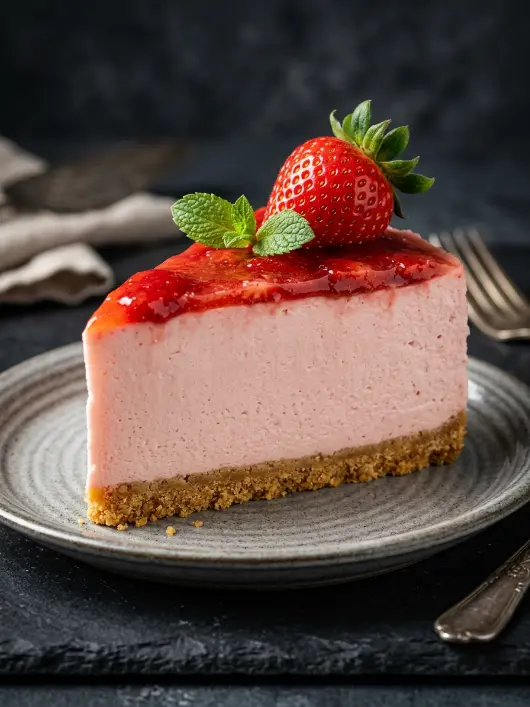
Flawless No-Bake Strawberry Cheesecake
Ingredients
Equipment
Method
- Construct the Crust Base: Pulse graham crackers in food processor until fine. Mix in melted butter and sugar. Pack tightly into bottom of 8-inch springform pan. Freeze for 10 minutes.
- Dehydrate the Berries: Puree chopped strawberries until smooth. Pour into saucepan with 2 tablespoons sugar. Simmer over medium-low heat for 12-15 minutes, stirring continuously, until reduced to exactly half volume (½ cup). Cool completely to room temperature.
- Homogenize the Cheese: In stand mixer with paddle attachment, beat block cream cheese and powdered sugar on medium-high speed for 3 minutes until smooth and fluffy. Mix in cooled strawberry reduction and vanilla extract.
- Build the Aerated Foam: In separate chilled bowl, whip heavy cream on high speed until stiff peaks form (2-3 minutes). Peaks must stand straight without drooping.
- Laminate the Mixtures: Add one-third whipped cream to strawberry cream cheese base. Stir vigorously to lighten. Gently fold in remaining whipped cream using 15-20 sweeping motions. Avoid deflating air bubbles.
- Crystallization Chill: Pour filling over frozen crust. Smooth top. Cover loosely with foil. Refrigerate minimum 6 hours (preferably overnight 8-12 hours) until firm. Slice with hot knife for clean cuts.
Notes
- Must use block cream cheese, not spreadable tubs—they contain excess water.
- Strawberry reduction to 50% volume is mandatory—do not skip.
- Heavy cream must be minimum 36% fat for proper structure.
- Refrigerate full 6 hours minimum for fat crystallization.