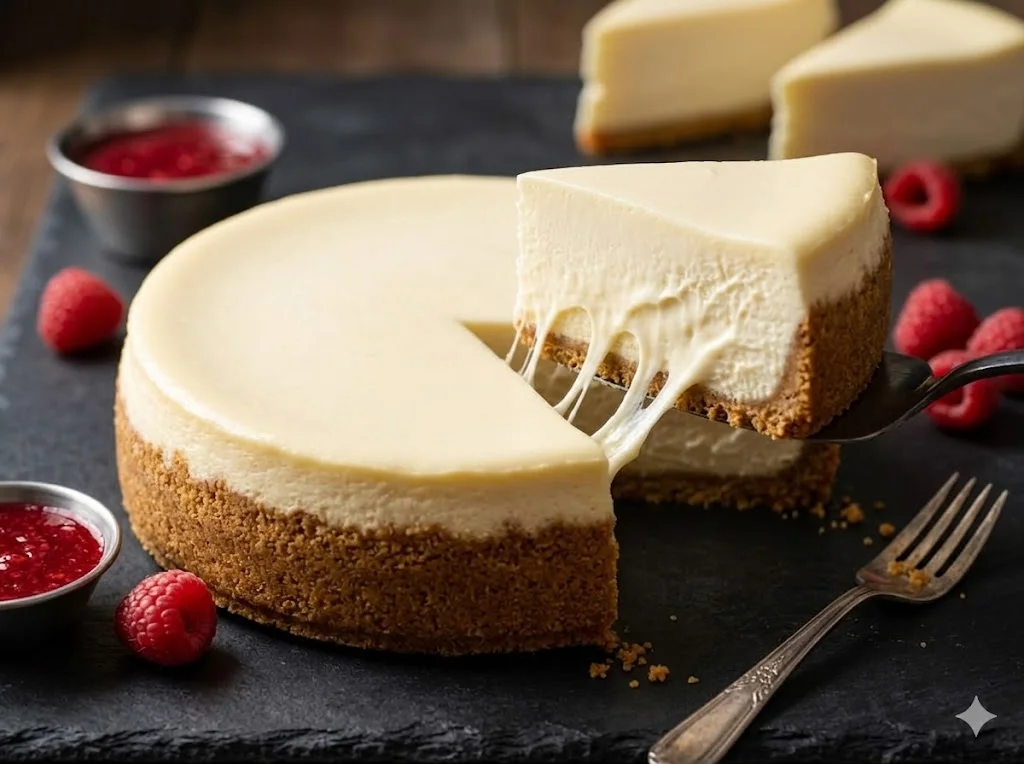
Ingredients
Equipment
Method
- STEP 1 - The Foundation: Graham Cracker Crust
- In a medium bowl, combine 1.5 cups (180g) finely ground graham cracker crumbs, 6 tablespoons (85g) melted unsalted butter, 2 tablespoons (25g) granulated sugar, and 0.25 teaspoon (1.5g) sea salt. Stir with a fork until the mixture resembles damp sand. Every crumb should be slightly moistened with butter, but the mixture should not be wet. Press this mixture firmly into the bottom of a 9-inch (23cm) springform pan using the bottom of a measuring cup. Compress it into a tight, even layer. The crust should be compact enough to hold together, but not so dense that it becomes hard. Do not press the crust up the sides—keep it on the bottom only. This prevents the crust from rising into the filling during baking. Set the prepared pan aside.
- STEP 2 - The Filling: Room Temperature Precision
- Remove 32 ounces (900g) of Philadelphia cream cheese from the refrigerator. Let it sit at room temperature for 30 minutes. Room temperature cream cheese blends smoothly and incorporates less air than cold cream cheese, which is critical for a crack-free surface. Add the room-temperature cream cheese to a stand mixer bowl. Beat at low speed for exactly 2 minutes. Stop immediately. Over-beating incorporates air, which creates bubbles that expand when heated and form cracks during cooling. Add 1 cup (200g) of granulated sugar. Beat at low speed for 1 minute until the sugar is incorporated. The mixture should look smooth and light, but not whipped. Add 4 large room-temperature eggs one at a time. After each egg, beat for just 30 seconds at low speed. Stop. Do not over-mix. Add 1 cup (240ml) sour cream and 1 teaspoon (5ml) Nielsen-Massey vanilla extract. Beat for 30 seconds at low speed. Stop mixing immediately. The filling should be smooth and creamy, but never whipped or airy.
- STEP 3 - Water Bath Setup: Thermal Protection
- Wrap the outside of the springform pan (bottom and all sides) with heavy-duty aluminum foil. Make sure the foil goes up the sides at least 2 inches (5cm) and covers the bottom completely. This prevents water from seeping into the crust. Place the wrapped springform pan inside a larger roasting pan (at least 3 inches / 7.5cm deep). Pour hot water into the roasting pan until it reaches halfway up the sides of the springform pan (about 1.5–2 inches / 4–5cm of water). This water bath will maintain an even, gentle heat around the cheesecake, preventing the rapid temperature differential that causes cracks.
- STEP 4 - The Oven Bake: Precision Temperature Control
- Preheat your oven to 325°F (163°C) for 15 minutes. Use an oven thermometer to verify the actual temperature. Many home ovens run 25–50°F hotter than the dial indicates. Carefully place the roasting pan (with the springform pan inside) into the preheated oven. Make sure the roasting pan is stable and level so water does not spill. Bake for exactly 75 minutes. Do NOT open the oven door during this time. Opening disrupts the temperature and causes uneven cooking. At the 65-minute mark, insert an instant-read thermometer horizontally through the center of the cheesecake (not touching the water bath below). At exactly 150°F (65°C) internal temperature, remove the cheesecake from the oven immediately. Do NOT bake past 150°F. Overcooking squeezes water out of proteins, causing dryness and cracks during cooling.
- STEP 5 - The Cooling Protocol: Preventing Thermal Shock
- Turn off the oven. Crack the door open about 2–3 inches (5–7cm) for 5 minutes. The oven is still warm, and the slightly open door allows the temperature to equalize slowly. After 5 minutes, open the oven door all the way and cool for another 5 minutes. Carefully remove the roasting pan from the oven using oven mitts. The water is still hot. Set it on the counter but be careful not to spill the water. Let the cheesecake sit in the roasting pan for 10 minutes. During this time, the water slowly cools and the cheesecake continues to cool gradually. Remove the springform pan from the roasting pan. Remove the aluminum foil. Place the cheesecake (still in the springform pan) on the counter. Let it sit at room temperature for another 5–10 minutes. Then refrigerate for at least 6 hours (overnight is ideal). This gradual cooling protocol ensures that the interior and exterior cool at approximately the same rate, preventing thermal shock and cracks.
- STEP 6 - Final Preparation: Release and Serve
- After at least 6 hours of refrigeration (overnight is best), remove the cheesecake from the refrigerator. Run a thin, warm knife around the inside edge of the springform pan to loosen the cheesecake from the sides. Carefully release the springform latch and remove the outer ring. Let the cheesecake come to room temperature for 15 minutes before slicing. This allows the creamy center to express itself. Slice with a hot, wet knife (wipe between slices) for the cleanest cuts. Serve with fresh berries, fruit compote, or simply on its own.
Notes
Calculated using USDA FoodData Central for Philadelphia cream cheese,
 large eggs, sour cream, and graham crackers. Values represent 1/12
of the total cheesecake. High fat content provides the creamy texture.
 This is a dessert designed for small portions—it is rich and deeply
 satisfying.