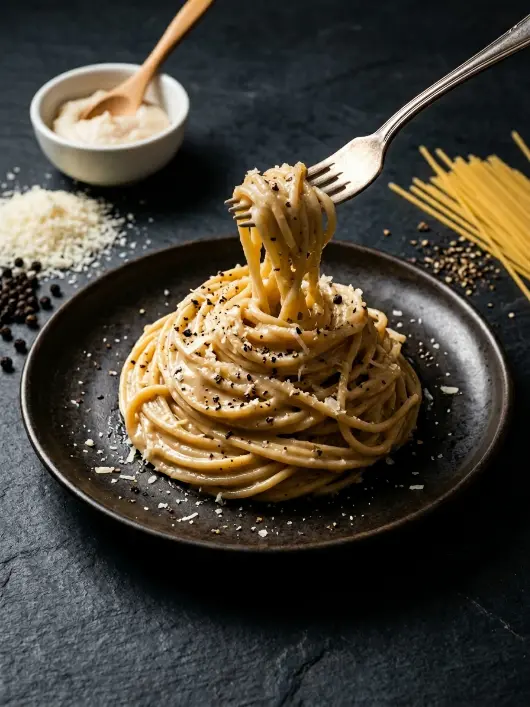
Ingredients
Equipment
Method
- Execute Restricted-Water Pasta Extraction: Place the 4 cups of filtered water and kosher salt into your shallow pan and bring to a rolling boil. Add the spaghetti. Cook the noodles until they are exactly 2 minutes shy of al dente, stirring frequently. The low volume of water forces the surface starches off the noodles into a dense, milky white liquid suspension.
- Desorb Volatile Black Pepper Oils: While the pasta cooks, place your coarsely cracked black pepper into your large shallow skillet over medium heat. Toast dry for 90 seconds until the fragrant, lipophilic piperine oils are released. If using butter, drop it in now to dissolve the toasted pepper compounds into the fat phase. Turn the pan heat to low.
- Synthesize the Umami Miso Slurry: Ladle exactly 1/3 cup of the boiling, starchy pasta water out of the pot and into a small bowl containing the white miso paste. Use a small whisk to mix the paste into the liquid until completely smooth and fluid with zero remaining lumps.
- Perform Interfacial Noodle Coating: Use tongs to transfer the undercooked spaghetti directly out of the boiling water and straight into the skillet containing the toasted black pepper. Pour the dissolved miso slurry over the hot noodles. Toss over low heat for 60 seconds, letting the pasta absorb the miso-spiced liquid layers.
- Execute Off-Heat Casein Emulsification: Remove the skillet completely from the heat source and set it onto a cool surface. Let the pan temperature drop slightly for 30 seconds to avoid exceeding the 155°F cheese-curdling limit. Dump the finely grated Pecorino Romano cheese across the surface.
- Agitate to Achieve Uniform Emulsion: Immediately toss and stir the pasta vigorously. Pour in an additional 2-3 tablespoons of the hot, ultra-starchy pasta water from the boiling pot. The rapid agitation combined with the high starch concentration binds the melting cheese fats to the water phase, creating a smooth, glossy sauce. Serve immediately on warmed plates.
Notes
Never add cheese while the skillet sits directly over an active burner; excess heat causes the protein molecules in the cheese to coil tightly and reject moisture, permanently splitting the sauce into stringy curd clumps and yellow grease.