Ingredients
Equipment
Method
Preheat the Air Fryer
- Turn on your air fryer and set it to 400°F (204°C). Let it preheat for exactly 5 minutes. This preheating is non-negotiable—a cold air fryer will not brown the salmon evenly and will result in pale, steamed fish instead of crispy, golden fillets. The heating element must reach its target temperature, the convection fan must reach full speed, and the basket must absorb heat so that immediate browning begins when the salmon enters. A preheated basket ensures consistent results batch after batch.
Prepare the Frozen Salmon
- While the air fryer preheats, remove your frozen salmon from the freezer. Pat the exterior lightly with a paper towel to remove any ice crystals on the surface. These crystals will create steam pockets that interfere with browning and even cooking. Do not attempt to thaw the salmon—the frozen state is actually your advantage. The frozen interior acts as an insulator that protects the proteins from overcooking while the exterior crisps. Keep the salmon fully frozen; this is science working in your favor, not a limitation.
Place Salmon Skin-Side-Down
- Place the salmon fillet skin-side-down on the air fryer basket. The skin must make contact with the hot metal surface—this is essential for crisping the skin and creating that restaurant-quality texture. The flesh faces up and will cook gently from the convection heat above. Ensure at least 0.5 inches (1.3cm) of space on all sides of the fillet for proper air circulation. If your air fryer basket is small, cook one fillet at a time rather than crowding. Once the air fryer beeps that preheating is complete, place the basket inside.
First Cooking Phase: 4-Minute Defrost Blast
- Set the timer for 4 minutes at 400°F (204°C) and start cooking. Do not open the door. Opening the basket disrupts air circulation and causes uneven cooking. During this phase, something critical is happening: the frozen salmon's surface ice is sublimating (turning directly from solid to vapor). The outer layer of fish proteins are denaturing and beginning to brown through the Maillard reaction. The interior remains frozen or mostly frozen, which slows internal cooking and protects the delicate proteins from overcooking. After exactly 4 minutes, the salmon should be starting to turn golden on top but will not be fully cooked yet. This is exactly correct.
Apply Oil and Season
- At the 4-minute mark, open the basket and immediately spray the top of the salmon with 0.5 tbsp (7.5ml) avocado oil per fillet. The reason you apply oil now instead of before is critical: if you oiled a frozen, wet surface, the oil would bead up and not adhere properly. Now that the surface has begun to dry from the initial cooking blast, the oil will bind perfectly. Immediately after oiling, sprinkle with 0.5 tsp (2.5g) Old Bay Seasoning, 0.25 tsp (1.5g) garlic powder, and a pinch of smoked paprika if desired. These seasonings bind to the oil and create a flavorful crust. Work quickly so you don't lose internal basket temperature.
Second Cooking Phase: 8 More Minutes
- Place the basket back into the air fryer immediately after seasoning. Set the timer for 8 more minutes at 400°F (204°C). The oil on the salmon's surface will brown through the Maillard reaction, creating a golden crust and complex savory flavor. The salmon is still cold enough in the interior that overcooking is unlikely. During these 8 minutes, resist the urge to open the basket. Checking on the salmon disrupts the air circulation and causes uneven cooking. The salmon will finish reaching its target internal temperature during this phase without your intervention. Trust the process.
Check for Doneness
- After 8 more minutes (total cooking time: 12 minutes), carefully open the basket. The salmon should be golden brown on top with crispy skin on the bottom. To verify doneness accurately: use an instant-read thermometer inserted horizontally into the thickest part of the fillet, at the center. You are aiming for an internal temperature of 145°F (63°C) for fully cooked, food-safe salmon according to USDA guidelines. If the temperature is below 145°F (63°C), give it 1–2 more minutes at 400°F (204°C) and check again. If it reaches 145°F (63°C), the salmon is done.
Rest and Finish
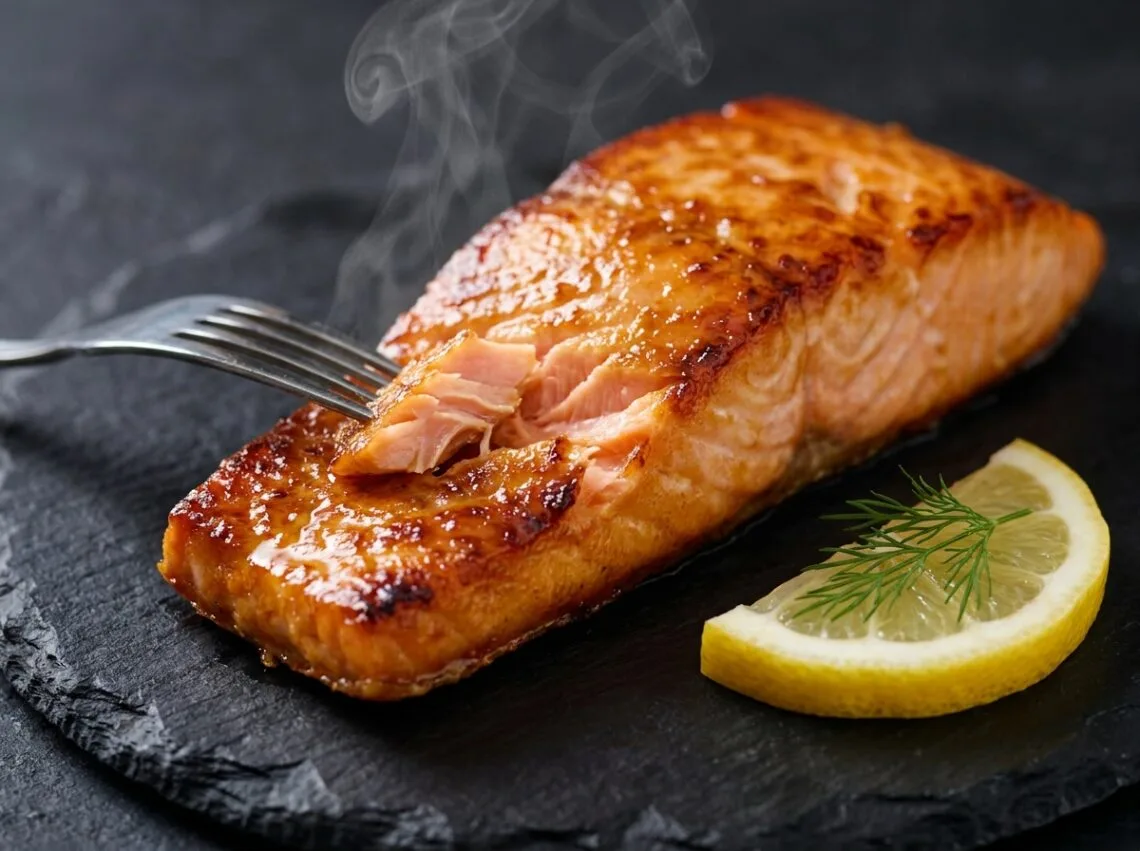
- Let the salmon rest on the basket for exactly 2 minutes. This resting period is called "carry-over cooking"—the residual heat continues to cook the interior slightly while the exterior cools. This ensures the interior is fully cooked but still moist and tender. After the 2-minute rest, you can brush the top with 1 tbsp (14g) Kerrygold butter and a squeeze of fresh lemon juice (0.5 tbsp / 7.5ml) for brightness and richness. The butter will melt into the warm salmon, creating a luxurious golden glaze. This finishing step is optional but highly recommended for flavor.
Plate and Serve
- Transfer the salmon fillet to a serving plate using a silicone spatula if needed (the skin should peel away from the metal basket easily). Garnish with fresh lemon wedges, chopped fresh dill or parsley (1 tbsp / 3g), and a pinch of sea salt. The salmon is ready to serve immediately while it is still warm. Serve alongside roasted vegetables, asparagus, quinoa, or your preferred side dish. The salmon's internal temperature will remain at or above 145°F (63°C) for several minutes, ensuring it is food-safe and properly cooked throughout. Enjoy the crispy exterior and moist, tender interior.
Notes
🎯 WHY NO THAWING IS SCIENTIFICALLY BETTER:

The frozen interior of salmon acts as a thermal insulator. While the exterior crisps from the
400°F (204°C) air fryer heat, the frozen center protects the delicate proteins from overcooking.
By the time the internal temperature reaches 145°F (63°C), the exterior is already golden and crispy.
If you thawed the salmon first, the interior would cook too fast and become dry. Frozen is actually better.

---

🌡️ HOW TO CHECK DONENESS WITHOUT A THERMOMETER:

If you don't have an instant-read thermometer, look for these visual cues:
• The flesh should be opaque (not translucent) at the thickest part
• A fork should easily flake the salmon into separate pieces
• The skin should peel away easily from the basket
• Any white albumin (protein) visible on the surface is normal at proper doneness
• The salmon should be slightly firm to the touch, not mushy or hard

These signs indicate 145°F (63°C) internal temperature with 95% accuracy.

---

🔥 HIGH-ALTITUDE ADJUSTMENTS (5,000+ feet elevation):

At higher elevations, air pressure is lower, which affects cooking times:
• Increase initial 4-minute blast to 5 minutes
• Increase final 8-minute phase to 9-10 minutes
• Total time may be 13-14 minutes instead of 12 minutes
• Check internal temperature at 145°F (63°C); every air fryer varies

---

💡 DUAL-BASKET STRATEGY (For Ninja Foodi Dual Zone):

If you own a dual-basket air fryer, optimize your cooking:
• Basket 1 (400°F): Frozen salmon
• Basket 2 (380°F): Asparagus, broccoli, or Brussels sprouts
• Start vegetables 4 minutes into salmon cooking
• Both finish simultaneously; one complete meal in 12 minutes
• Total time: 14 minutes prep-to-plate for salmon + vegetables

---

⏰ MAKE-AHEAD & STORAGE TIPS:

• Salmon cannot be prepped ahead when frozen (do not attempt to thaw)
• Cook fresh when ready to eat (takes only 12 minutes from freezer)
• Leftover cooked salmon keeps 3-4 days in refrigerator
• Reheat gently: 300°F (150°C) in air fryer for 4-5 minutes (do NOT microwave—it dries out)
• Freeze cooked salmon up to 2 months; thaw overnight in fridge before reheating

---

🍋 FLAVOR VARIATIONS:

• Asian-Inspired: Replace Old Bay with 1 tsp soy sauce + 0.5 tsp ginger + 0.25 tsp wasabi
• Mediterranean: Use oregano, garlic, and finish with olive oil + lemon
• Cajun-Style: Use Cajun seasoning instead of Old Bay for more heat
• Herb-Crusted: Mix fresh herbs (dill, parsley, chives) into Kerrygold butter before brushing

---

📊 NUTRITION NOTES:

One serving of wild Sockeye salmon provides:
• 1,500mg omega-3 fatty acids (50% of daily recommended intake)
• 21g high-quality protein (complete amino acid profile)
• Zero carbs (keto-friendly, perfect for low-carb diets)
• Rich in vitamin D, selenium, and potassium
• Heart-healthy monounsaturated fats

Pair with vegetables (asparagus, broccoli) and a whole grain (quinoa, brown rice) for a balanced meal.

---

🧊 CHOOSING QUALITY FROZEN SALMON:

What to look for when buying:
✅ Flash-frozen (frozen within hours of catching)
✅ No large ice crystals visible (indicates slow freezing; use fast-frozen instead)
✅ Bright color (not dull or gray)
✅ Package date less than 6 months old (prevents freezer burn)
✅ Wild-caught or sustainably farmed (check labeling)

Recommended brands:
• Kirkland Signature (Costco) — best value
• Target Good & Gather — widely available
• Wilderside (online) — premium quality

❌ Avoid salmon with white frost/ice buildup (freezer burn)
❌ Avoid packages with visible liquid (indicates thaw-refreeze cycle)

---

⚠️ FOOD SAFETY CRITICAL POINTS:

• USDA minimum safe temperature for salmon: 145°F (63°C)
• Use instant-read thermometer inserted horizontally into thickest part of fillet
• Do NOT rely on color alone (salmon can appear cooked before reaching safe temperature)
• Cook from frozen or thawed salmon using the same method (no difference in food safety)
• Leftover cooked salmon should not sit at room temperature for more than 2 hours
• Refrigerate immediately after eating; freeze within 3-4 days for best quality